LG’s phone business is gone. Its appetite for making absolutely ridiculous phones, though? That deserves to be remembered.
My read on what went wrong is pretty simple: LG kept trying wild ideas without also having a steady, consistent moneymaker to keep the whole operation alive. The experiments were why we loved them. But experiments alone weren’t enough.
Right before shutting down its mobile business in 2021, LG had one more idea in development: a smartphone that physically rolls open into a small tablet. It never went on sale. Now, thanks to dbrand somehow getting hold of one, I’ve been able to use it.
And this isn’t just a display attached to a barely functioning concept. There’s working hardware, working software, custom animations, and an impressive amount of engineering. LG got surprisingly far with this thing.
Quick Summary
- LG’s unreleased rollable expands from a 6.7-inch phone into a wider 7.4-inch mini tablet.
- Working software includes adaptive layouts, animated wallpapers, and rear-screen camera previews.
- Strong motors and protective behavior show thoughtful engineering, but durability remains a major concern.
- The display has less pronounced creasing than a foldable, but still shows some waviness.
LG Was Already Making Some Pretty Wild Phones
The LG Velvet and LG Wing were among the company’s final releases. And the Wing was already nuts.
At first, it looked like a normal phone. Then you could swivel the spring-loaded main display into a horizontal position, revealing a smaller, almost square screen underneath. Suddenly, you had a T-shaped phone. For reasons.
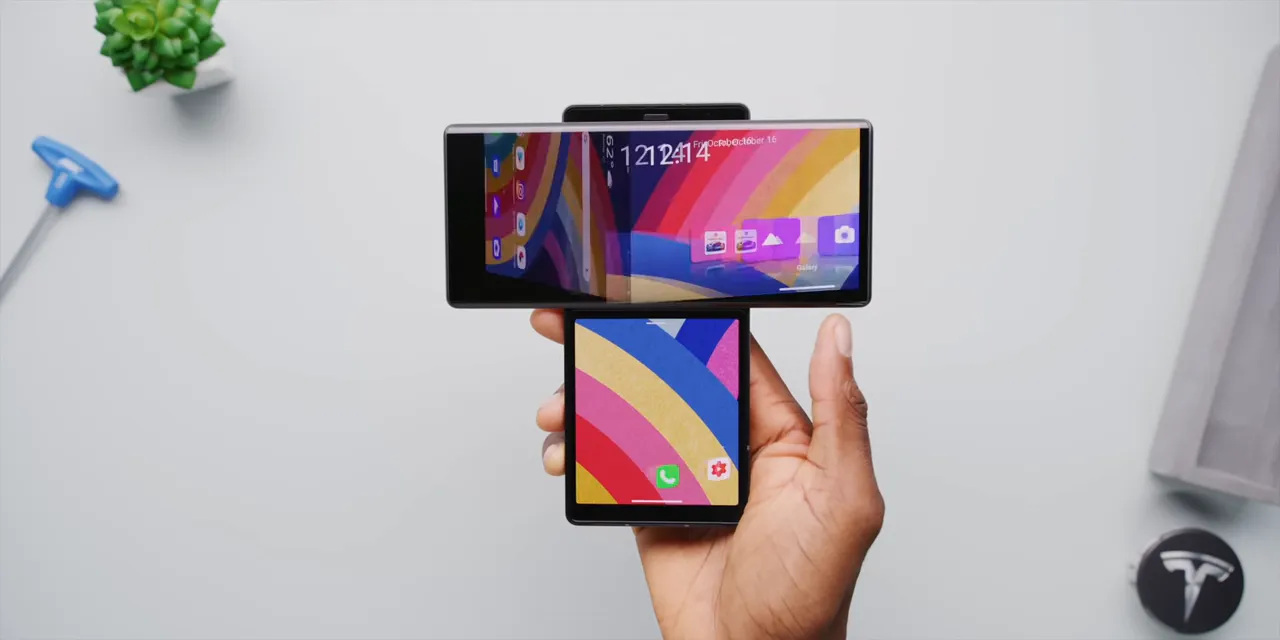
What impressed me wasn’t just that LG made the mechanism work. It was all the engineering and software needed to make something that strange feel intentional.
The G8X had a different approach. Early in the folding phone era, LG tried to deliver some of the same dual-screen functionality at a fraction of the price by putting a second display in a case. You plugged the phone into it, and there was your dual-screen setup.
That also meant solving a bunch of smaller problems: making the hinge fold all the way around, and providing magnetic charging adapters so you could still fast charge while the case occupied the USB port.
These were genuinely clever products. They just didn’t give LG the dependable commercial foundation it needed. By 2021, the mobile operation was shutting down, right around the time rumors of a rollable smartphone were circulating. LG had already demonstrated a rolling TV at CES a couple of years earlier. Apparently, shrinking that idea into a phone was next.
From a 6.7-Inch Phone to a 7.4-Inch Mini Tablet
The basic concept is easy to understand. Closed, the LG rollable has a display measuring about 6.7 inches diagonally. From the front, it looks reasonably close to a regular slab phone.
Swipe across the screen with three fingers, and the entire device expands sideways. The display rolls out with it, becoming a more square 7.4-inch screen. Make the reverse gesture, and it rolls closed again.
It’s like carrying a tiny motorized scroll in your pocket. Which is a very LG sentence.
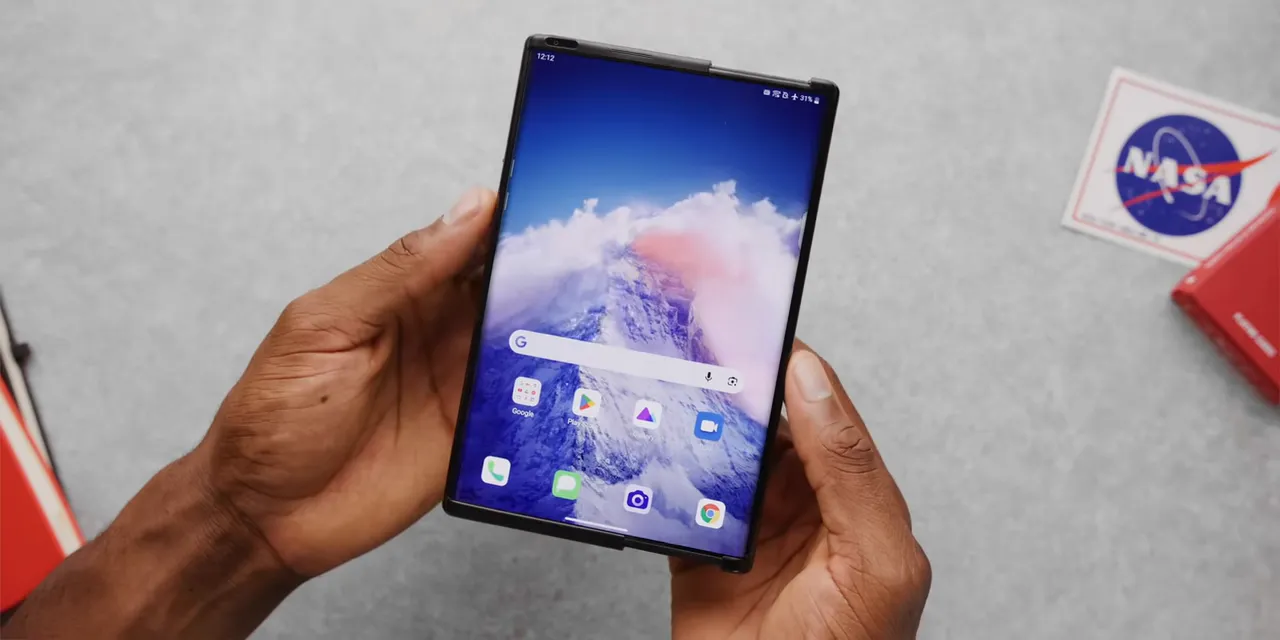
Going from 6.7 to 7.4 inches doesn’t sound dramatic on a spec sheet. But diagonal measurements don’t tell the whole story when the proportions change this much. The narrow phone becomes a substantially wider surface, closer to a mini tablet.
The appeal makes sense: maybe you want a larger display in your pocket, but you don’t want a conventional foldable. A rollable offers another way to get there, without folding the screen sharply in half.
Of course, coming up with that idea is the easy part. Actually building it is where things get ridiculous.
Where Does the Extra Screen Go?
That additional display has to live somewhere when the phone is closed. LG’s solution is to hide it in plain sight.
From the front, the screen appears to curve over the edges, a little like older Samsung phones from the era when heavily curved displays were everywhere. But on the right side, it continues around the edge, behind a rail, and onto the back of the phone.
LG put clear glass over that rear section, so the unused portion of the display is still visible. Better yet, it can actually do things.
- Show messages on the back of the phone.
- Display a camera interface and preview.
- Let you frame selfies using the rear cameras.
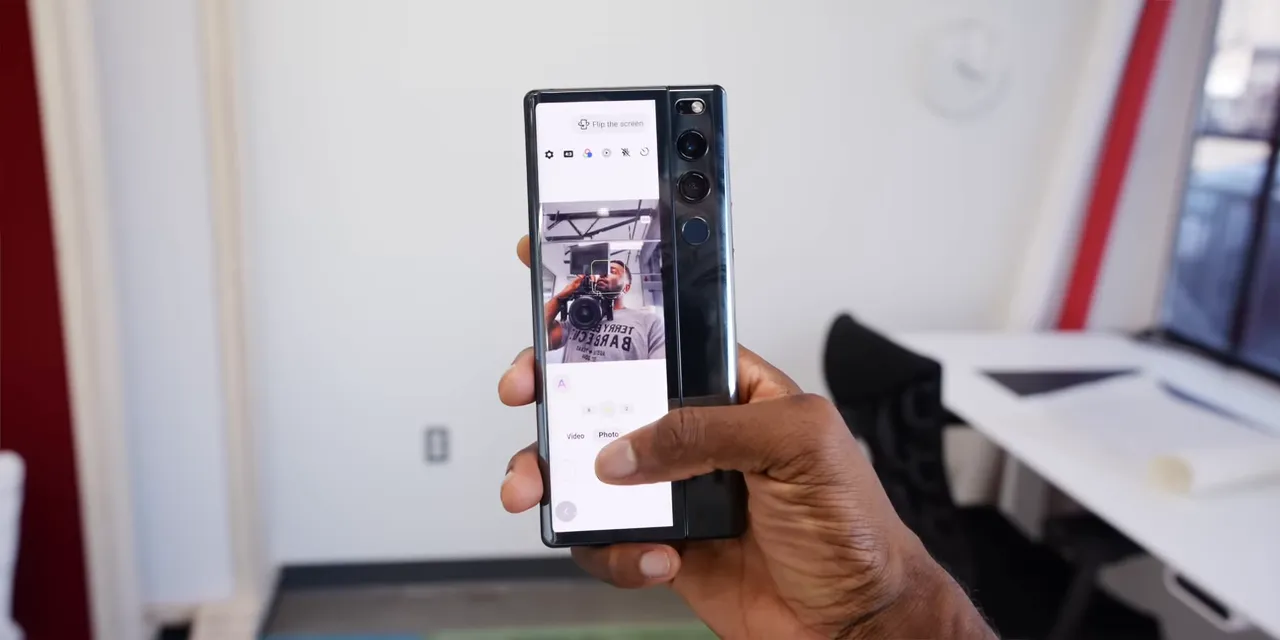
Those rear cameras are a 64-megapixel main camera and a 12-megapixel ultrawide. Being able to use the main cameras for selfies is a nice little bonus from a screen that already has to be back there anyway.
It reminds me of the Xiaomi Mi Mix Alpha, another concept phone that never went on sale. That device didn’t expand, but its display wrapped around almost the entire body. Xiaomi used the sides and back for extra software features, chasing an absurd screen-to-body ratio. LG’s rollable has some of that same energy, except here the wraparound display is also part of the expansion mechanism.
Even the buttons needed a rethink
With the screen and rails taking up the sides, there isn’t much room for ordinary buttons. The volume controls are pressure-sensitive areas near the top of the left edge, roughly where physical volume buttons would normally sit.
The power button moves to the back, below the cameras, and doubles as a fingerprint reader. That sounds awkward, but it’s surprisingly easy to reach.
The Software Makes It Feel Almost Ready
The most surprising part isn’t simply that the phone opens. It’s that LG had already started polishing the experience around it.
One lock screen has a flower animation that changes with the hardware. Expand the phone, and the flower blooms across the wider display. Roll it closed, and it shrinks back to a single petal. It’s a small touch, but it makes the screen’s movement feel deliberate rather than like a weird interruption.
The Settings app is another good example. As the display widens, the interface slides over to add a second column. Close the phone, and that extra column slides away.
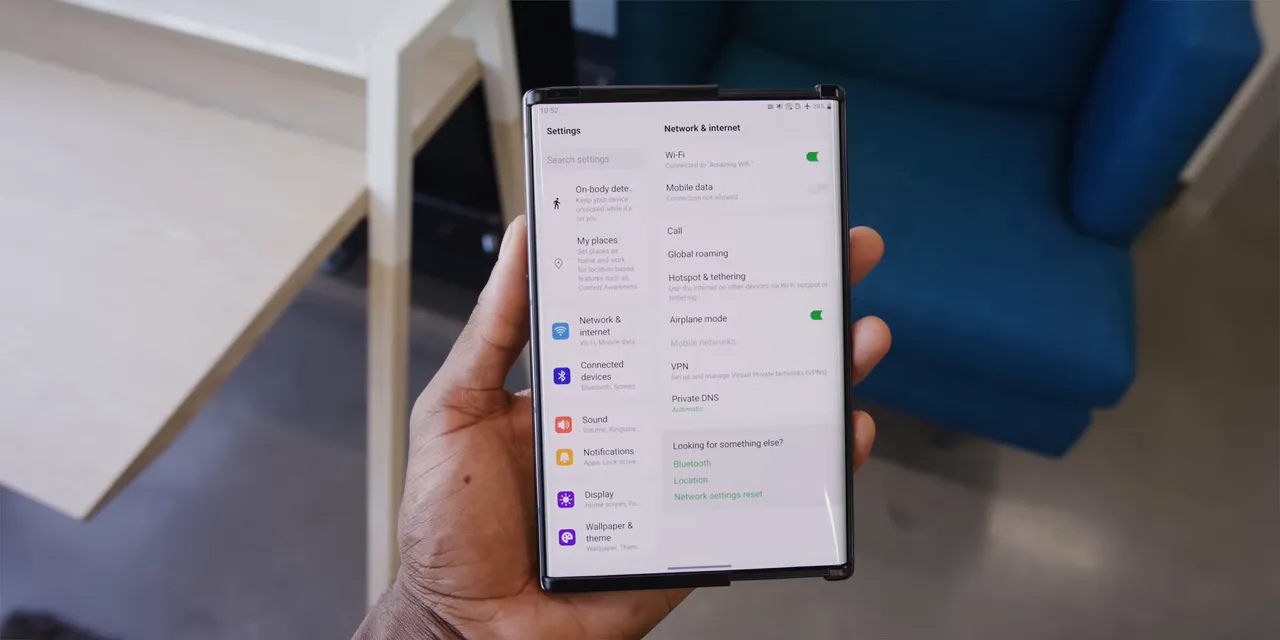
The software understands that the screen is changing shape. It isn’t just stretching a narrow interface to fill a wider rectangle.
None of this proves the phone was ready for a retail launch. But it does show how far development had progressed. LG was already working on the details that make an unusual piece of hardware feel like a coherent product.
Five Things You Only Notice When You Use It
1. The motors are surprisingly strong
I expected the expansion mechanism to be fairly delicate. It pushes back against resistance harder than you might think.
In fact, the phone could push a 16-inch MacBook Pro across a table with the laptop’s rubber feet down. That’s roughly five pounds of laptop. Obviously, that doesn’t make the phone unbreakable, but it is an impressive amount of force from something this small.
There’s also some protective behavior built in. With the phone expanded, squeezing it hard enough can trigger it to finish closing itself, followed by an error message. LG had clearly considered what should happen when the mechanism encounters pressure.
2. Yes, it can pinch things
My fingers were mostly too large to get caught in the gaps at the back or bottom. Smaller objects are another story.
The phone can trap a microfiber cloth as it closes, then lift it along with the device. So, yes, the moving chassis can pinch things. This is not a mechanism I’d treat casually around loose fabric.
3. Durability would have been a major question
I wouldn’t assume this prototype has meaningful water or dust resistance. There’s no confirmed IP rating here, and the construction gives plenty of reasons to be cautious.
When it’s expanded, you can see gear teeth at the top and bottom, along with gaps around the moving parts.
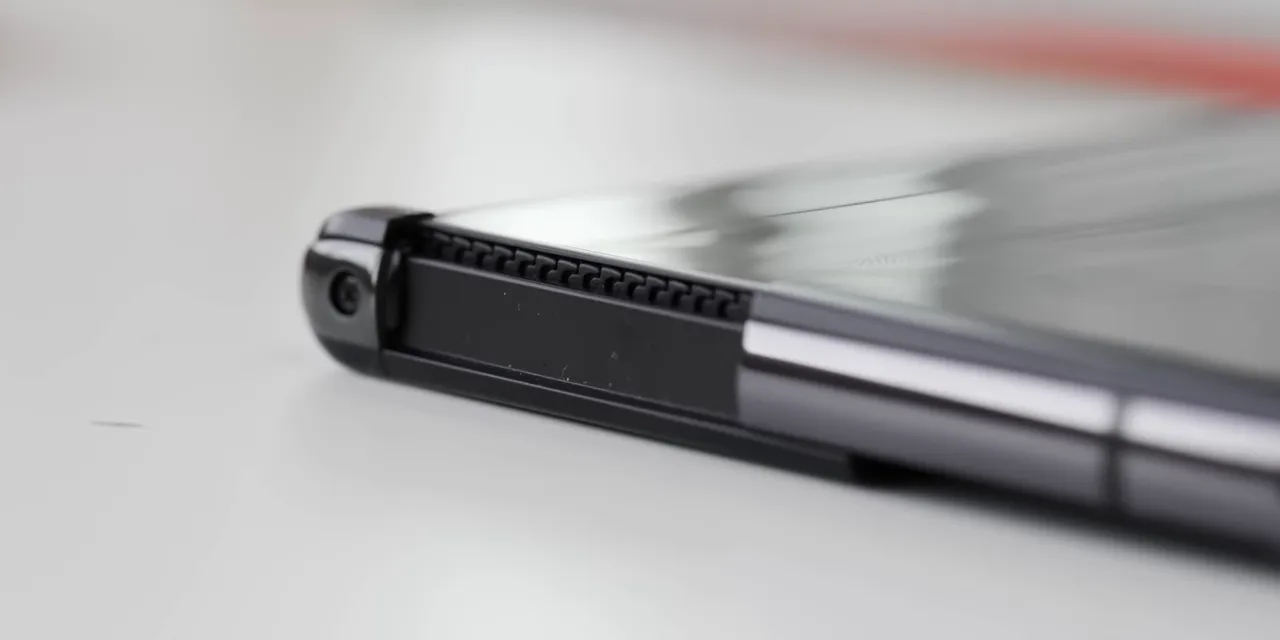
Then there’s the flexible display itself. Unlike an inward-folding phone that protects its softer inner screen when closed, this design leaves the flexible display exposed on the outside.
Between that and the moving mechanism, long-term durability would have been one of my biggest questions. That’s a concern based on the design, not a measured failure rate for a product that never shipped.
4. The opening sound is customizable
The phone plays a sound through its speakers every time it opens or closes. My suspicion is that it’s meant to help mask the motors, although you can still hear them.
There’s something very funny about imagining an engineer trying to find exactly the right sound to disguise a tiny motorized phone unfolding itself. An extremely specific assignment.
LG included several different sound options, each roughly matching the time the mechanism takes to move. You can also turn the effect off entirely. The motors are still audible on their own.
5. Less crease doesn’t mean no crease
A rollable display doesn’t have to bend in half around the tight radius of a foldable hinge. That is a real advantage.
But the screen still curves around the side of the phone, and that leaves a little waviness across the expanded surface. It’s easier to see with the display turned off.
It’s much less pronounced than some folding-phone creases, and I didn’t find it a huge deal. Still, this is not a perfectly flat, completely crease-free display.
The Inside Is Just as Overengineered
Digging through the settings turned up a 4,500mAh battery and 12GB of RAM. Those are interesting details, but this isn’t a normal phone review. There’s no retail product to recommend and no price against which to judge the specs.
The internal engineering is the more fascinating part. Zack from JerryRigEverything also got one and took it apart. His LG rollable teardown reveals two motors driving the opening and closing, plus three spring-loaded arms that help push the chassis sideways as the screen unrolls.
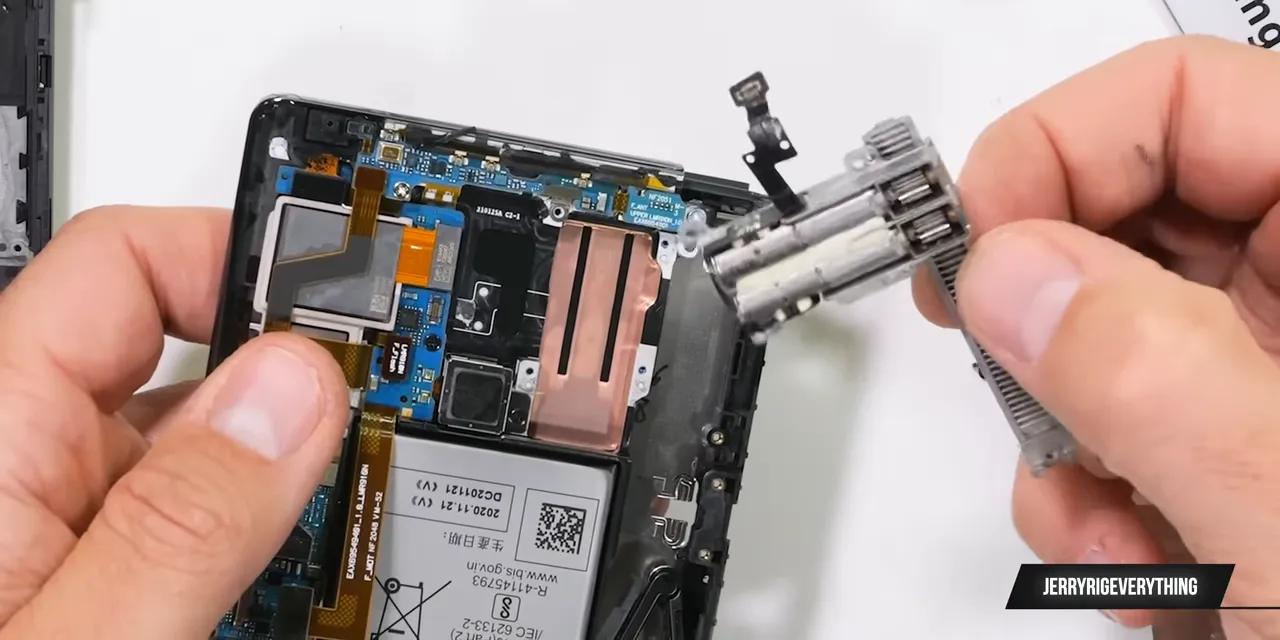
Seeing all of that packed into a phone makes the working prototype even more impressive. There’s a lot happening behind what looks, from the outside, like a simple sideways expansion.
A Working Phone That Ran Out of Time
We don’t know what LG would have charged for this phone. We don’t know what final name it would have used. And we don’t know how well it would have survived years of everyday use.
What we do know is that LG got far beyond a render or a display mockup. This is functional hardware with working software, dedicated features, and thoughtful little touches. The mobile business simply didn’t survive long enough to ship it.
It feels like exactly the kind of phone only LG would try to sell. Although there have also been rumors of Samsung working on a rollable smartphone, so the idea may not be finished. Whether that becomes a real product, and when, remains uncertain.
For now, this unreleased LG rollable is a fascinating glimpse of a different direction smartphones could have taken. Clever, complicated, slightly impractical, and absolutely wild. Very LG.


