The NBA players are not the only talented people in the arena.
I posted a clip of a broadcast camera operator tracking a basketball, and it went kind of viral. Then my reply pointing out that the lens cost about $200,000 also went viral. But mixed into the reactions were people saying it looked easy. Just follow the ball, right?
No. Keeping a fast-moving ball centered while manually adjusting focus and zoom is incredibly difficult. I know because I got to try it.
Thanks to NBC and the Spurs, I also got an up-close look at the cameras, microphones, controls, and broadcast trucks behind an NBA playoff production. The expensive lenses are wild. But the bigger surprise is how much coordination it takes to turn all that equipment into a finished live broadcast.
Table of Contents
- Key Takeaways
- A $50,000 Camera With a $200,000 Lens
- The Camera Operators Are Following More Than the Ball
- The Sweeping Tip-Off Shot Takes Two People
- The Basketball Stanchion Is Loaded With Gear
- The Other Cameras That Complete the Coverage
- The Microphones Make the Arena Feel Alive
- The Broadcast Trucks Are Where Everything Comes Together
- How Slow-Motion Replays Arrive So Quickly
- The Best Broadcast Technology Disappears
Key Takeaways
- Precision basketball coverage requires simultaneous manual focus, zoom, tracking, and communication with the broadcast director.
- Specialized cameras and hidden microphones capture distinct angles and sounds throughout the arena.
- Broadcast truck crews combine dozens of sources into a polished production entirely in real time.
- Replay operators use tactile controls and high-frame-rate footage to deliver slow motion seconds after a play.
A $50,000 Camera With a $200,000 Lens
Many of the broadcast cameras around this arena are Sony HDC-P50s. They are compact box cameras with sensors smaller than a 1-inch type sensor, and the setup here delivers 1080p at 60 frames per second. They also have a global shutter, and each camera costs roughly $50,000.
But the camera body is almost the understated part of the setup. The Canon lens attached to it is ridiculous.
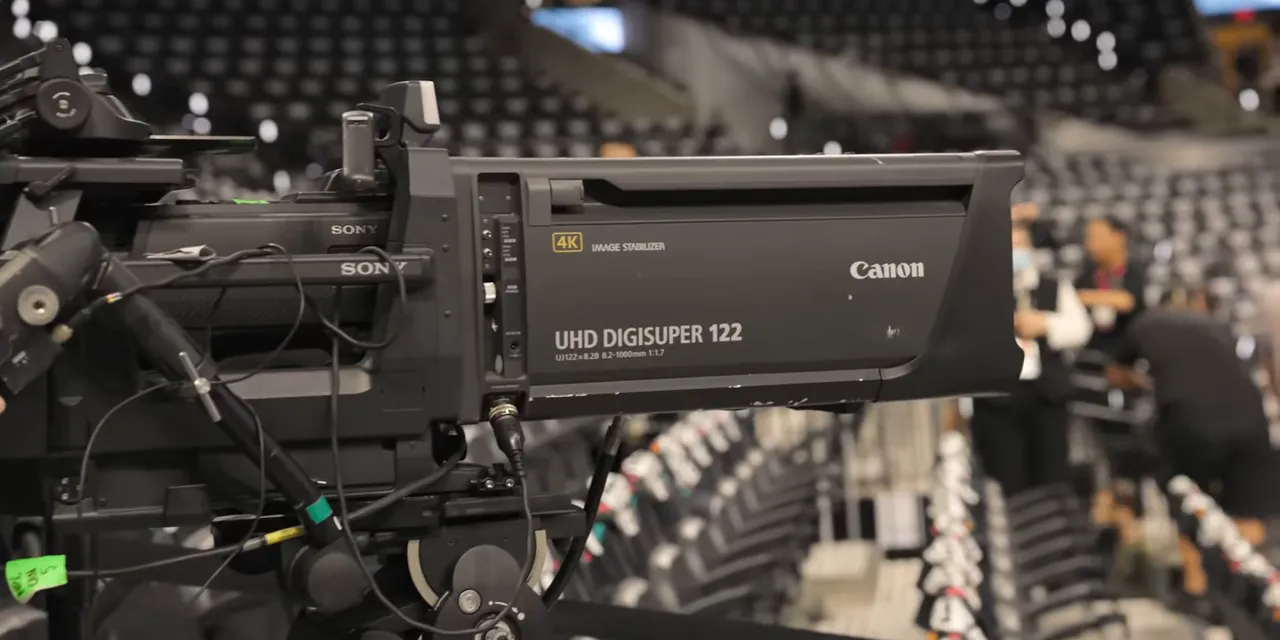
This is the Canon 122, named for its 122x optical zoom. Its focal range runs from roughly 8mm to 1,000mm. It combines that enormous range with powerful stabilization and servo motors that move the glass quickly and accurately.
That means the operator can move from a wide view to a tight close-up incredibly quickly, using actual motorized optical zoom. It is an insane amount of reach.
The camera sits on a fluid head that makes panning and tilting feel beautifully smooth. Out of curiosity, I looked up the price of that part, too: about $25,000. Just for the head.
Simple Controls, Extremely Difficult Shots
The controls are surprisingly intuitive:
- Right side: A dial controls zoom.
- Left side: A twisting handle controls focus.
- The fluid head: Lets the operator smoothly aim the whole assembly.
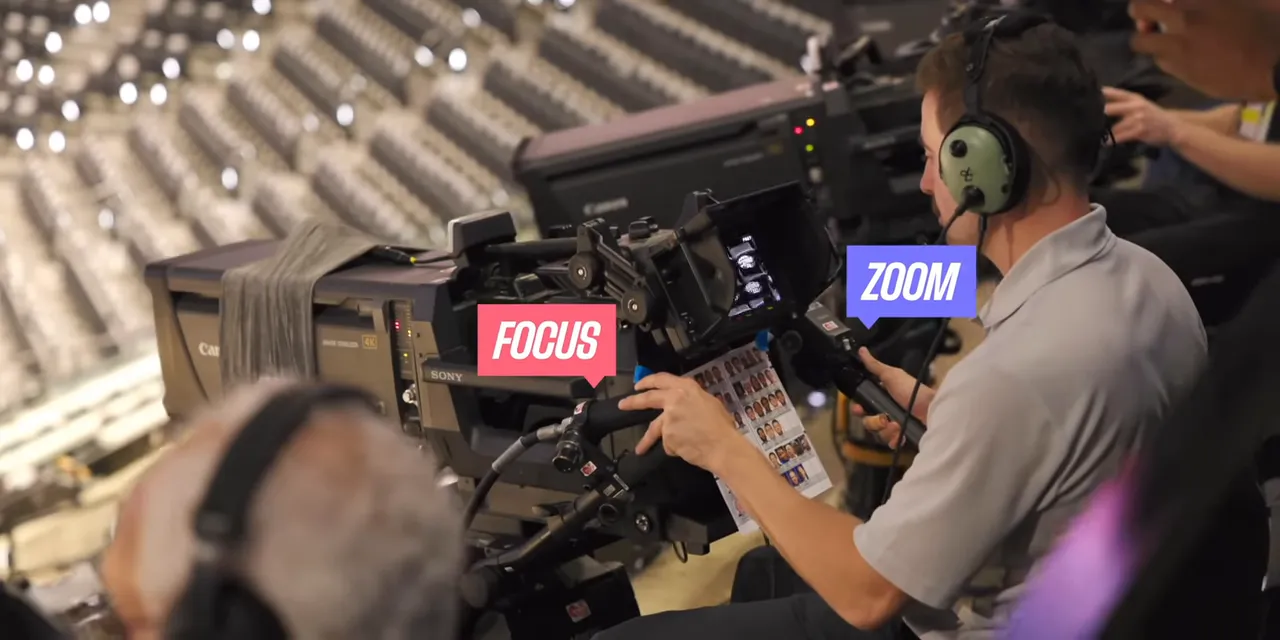
I could pick up the basic operation pretty quickly. Flying in and out with that zoom is genuinely fun. But understanding the controls and making a professional tracking shot are completely different things.
The operator has to aim, zoom, and rack focus at the same time, keeping an unpredictable moving subject framed correctly throughout. Even with this incredible equipment, I could not get close to the tracking these professionals do.
Intuitive to learn. Difficult to master. That became a recurring theme throughout the whole production.
The Camera Operators Are Following More Than the Ball
There is another layer to the job that is easy to miss: every camera operator is also wearing a headset and taking directions from the broadcast team.
At any moment, the director might ask for an ISO shot, meaning an isolated shot of a particular player. The operator then has about two seconds to identify that person, locate them, zoom in, focus, and deliver a usable image.
These crews work across the country, covering different teams. So that little sheet of player faces attached below the camera monitor? That is a genuinely useful tool, not a shortcut to make fun of.
The main elevated camera position has a dedicated bank of six cameras, with operators sitting in swiveling chairs. Honestly, it looks like a pretty cozy setup until you consider everything they are doing.
Those six cameras have specific assignments:
- One wide game camera.
- One tight game camera.
- Two dedicated player ISO cameras.
- One coach ISO camera.
- One camera for the mobile vertical broadcast.
This is where those incredibly precise ball-tracking shots come from. The operators are not simply pointing cameras toward the court. They are constantly managing composition, manual focus, zoom, and incoming instructions.
The Sweeping Tip-Off Shot Takes Two People
One of my favorite NBA shots is the huge, sweeping introduction that descends from the top of the arena toward the players at tip-off. It is so recognizable that it is even recreated in NBA 2K.
The real version comes from a cable camera.
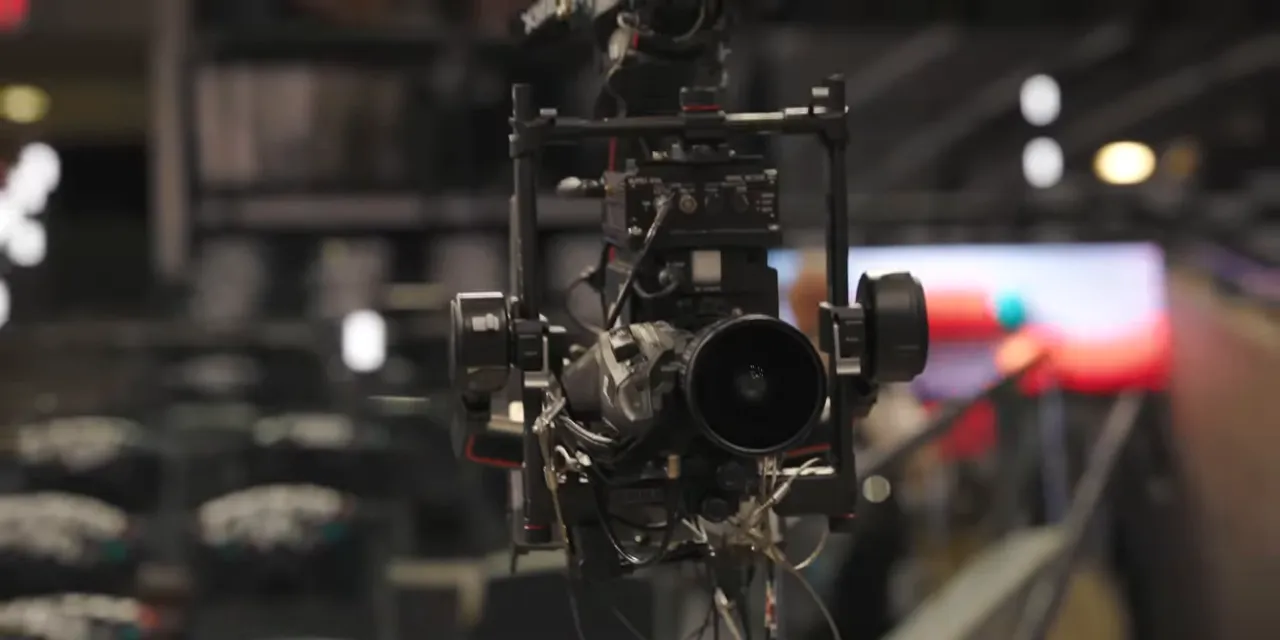
This rig uses another Sony P50, this time with a Canon 14x lens mounted on a Ronin 2 gimbal. Video and controls are transmitted wirelessly to two operators stationed in a corner of the arena.
The division of labor is important:
- One operator moves the rig through the arena in three-dimensional space.
- The other controls the image: where the camera points, how far it zooms, and what is in focus.
Those sweeping shots are a coordinated move between two people, not one person casually steering a flying camera.
I got to try the camera-control side. I had to listen carefully to the person moving the rig, then combine that movement with what I thought would make a nice shot. It felt a little like flying a drone, except someone else was handling the position while I handled the camera.
It was super fun, and I thought the results looked pretty great. But the teamwork is the whole thing.
Also, seeing this elaborate assembly connected to the overhead cables through what are essentially four carabiners is pretty funny. Shout-out to those carabiners.
The Basketball Stanchion Is Loaded With Gear
The stanchion supporting each hoop is much more than a support structure. It is packed with cameras and microphones from bottom to top.
It makes sense when you think about the location. This is about as close as equipment can get to the action without actually being out on the playing surface. Broadcast crews and press photographers both make use of it, so there is a huge variety of equipment serving different purposes.
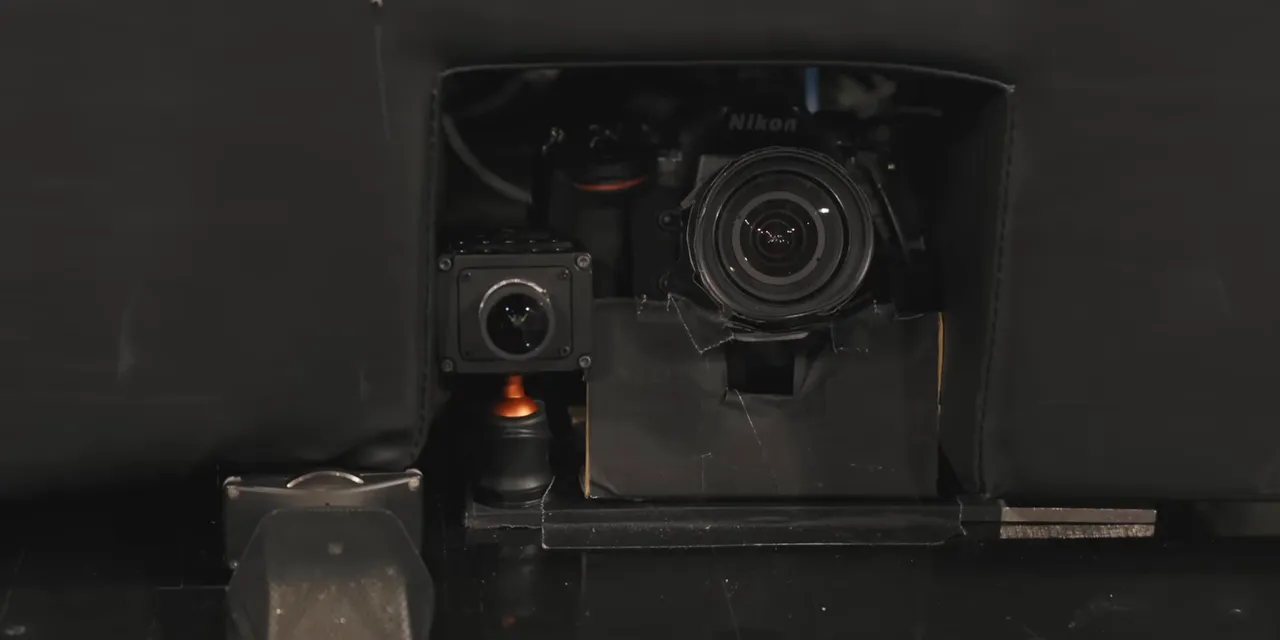
At Floor Level
A cutout at the bottom houses an ultra-wide camera and a floor microphone. That position captures a low angle on the action, along with sneaker squeaks, player chatter, trash talk, and complaints to the referees.
Along the Support
Farther up, I spotted a RED camera, a Sony a9, and what looked like a Canon R6. There are also shotgun microphones mounted around the structure.
A lot of those microphones are Sennheiser MKH 416s, which I have a soft spot for. It is the same microphone I use for my own recording, so that was a familiar piece of gear in a very different environment.
Behind the Backboard
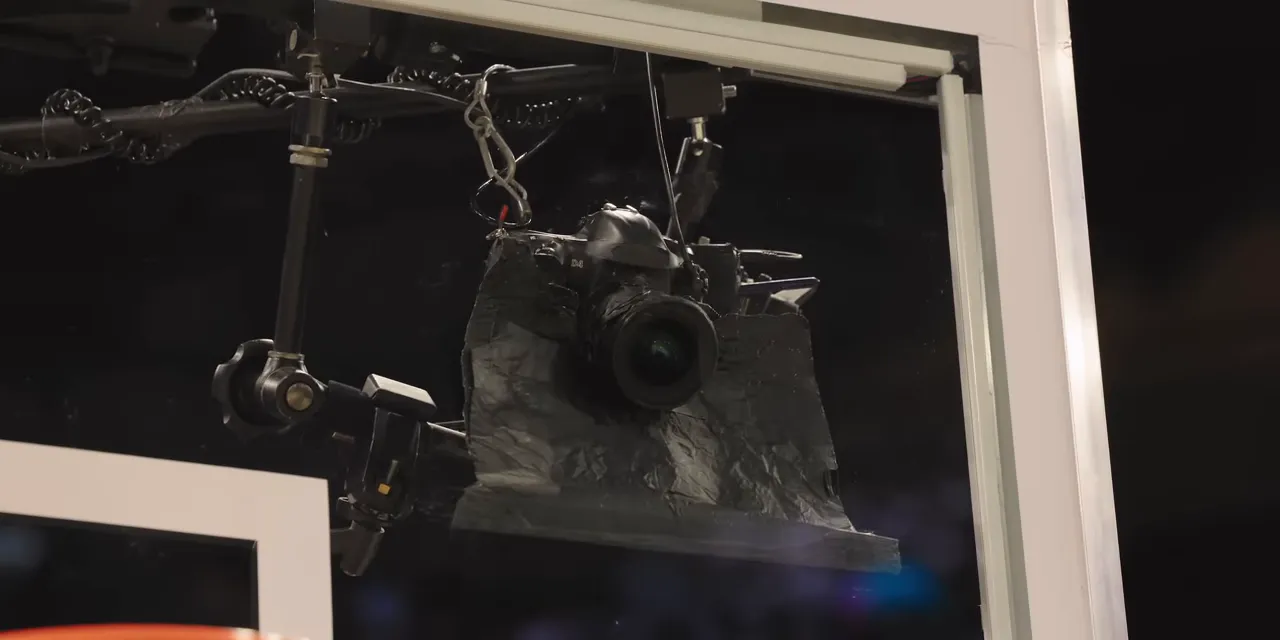
There are two more cameras behind the glass: one for broadcast video and one for still photographs.
The video setup is another Sony P50 with a Canon lens. The stills camera on the other side is a Nikon D4. Around its lens is a black taped surround, a common trick for reducing reflections from the backboard glass.
Above the Rim
My favorite might be the camera mounted above the entire backboard, even higher than the shot clock, pointing down.
That location gives the broadcast those amazing top-down views of shots, dunks, and everything happening directly below the basket. It is remotely operated, too. At a game, spend a few minutes looking at that camera and you will notice how much it moves.
The Other Cameras That Complete the Coverage
Altogether, there are easily 40 to 50 cameras distributed around the arena for different jobs. Not every angle needs a giant box lens.
One classic is the camera that captures the referee speaking at the scorer’s table. That is a remotely controlled, pivoting Panasonic dome camera.
Then there is the Steadicam operator, who heads onto the court as soon as a timeout or another appropriate break creates an opening. That person is constantly working, getting close-ups of players as they move away between plays.
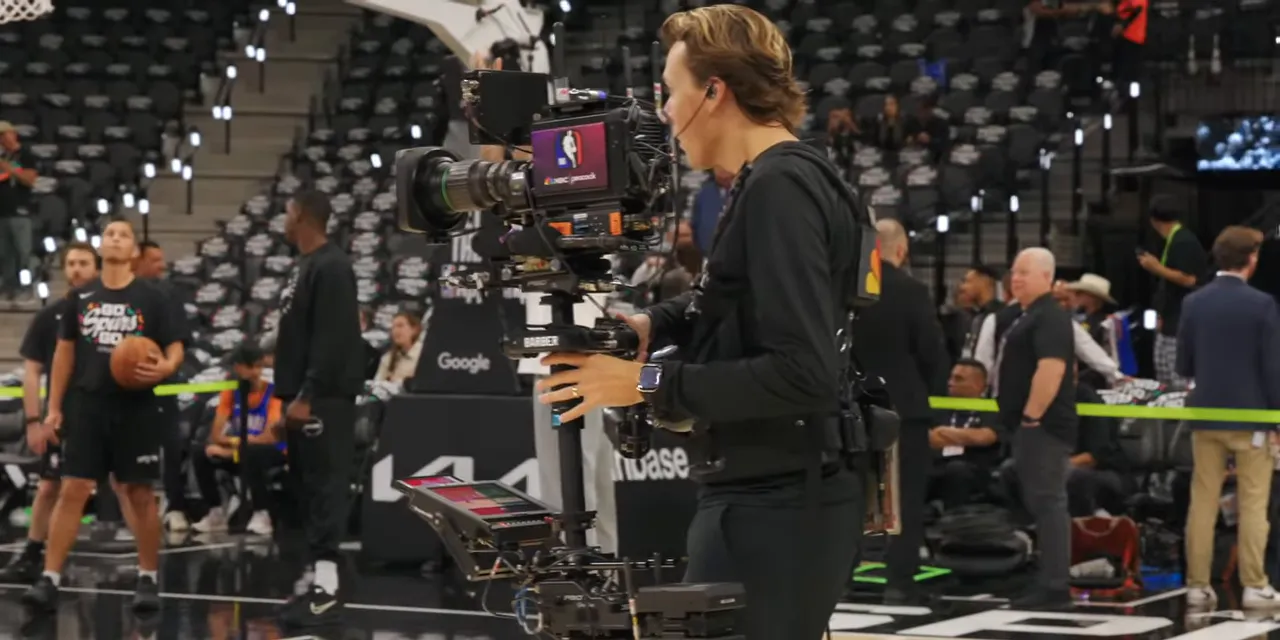
To me, this is easily one of the most dynamic cameras in the production because it moves so much and gets so close to the players.
The camera itself is, once again, a Sony P50 with a Canon 14x lens. The huge support rig distributes most of the load toward the operator’s waist rather than putting it straight onto their back. There is a lot of engineering behind making those mobile close-ups possible.
The Microphones Make the Arena Feel Alive
The camera angles are only half the experience. There are also microphones hidden all around the court, capturing specific parts of the game.
Think about the sounds that make basketball feel like basketball:
- The ball dropping through the net.
- A shot bouncing off the rim.
- Sneakers squeaking across different parts of the floor.
- Players calling to each other.
- The crowd reacting to a big play.
Those details need microphones close enough to pick them up. A camera can zoom across the arena, but capturing an intimate court sound means getting a microphone down near its source.
The crowd matters just as much. The sound needs to communicate the energy in the building while still leaving room for the commentators to be clearly understood.
For a deeper look at the audio side, Dallas Taylor’s tour of NBA microphones follows audio engineer Ben around the arena, explaining where the microphones are and what each one contributes. It is a really fun breakdown of an easy-to-overlook part of the production.
The Broadcast Trucks Are Where Everything Comes Together
All those cameras and microphones are impressive. But the part I had thought less about was how their feeds become one coherent broadcast.
About 200 yards from the arena was a cluster of broadcast trucks. For this playoff game, there were six of them. And there was far more equipment inside those trucks than I had seen around the court.
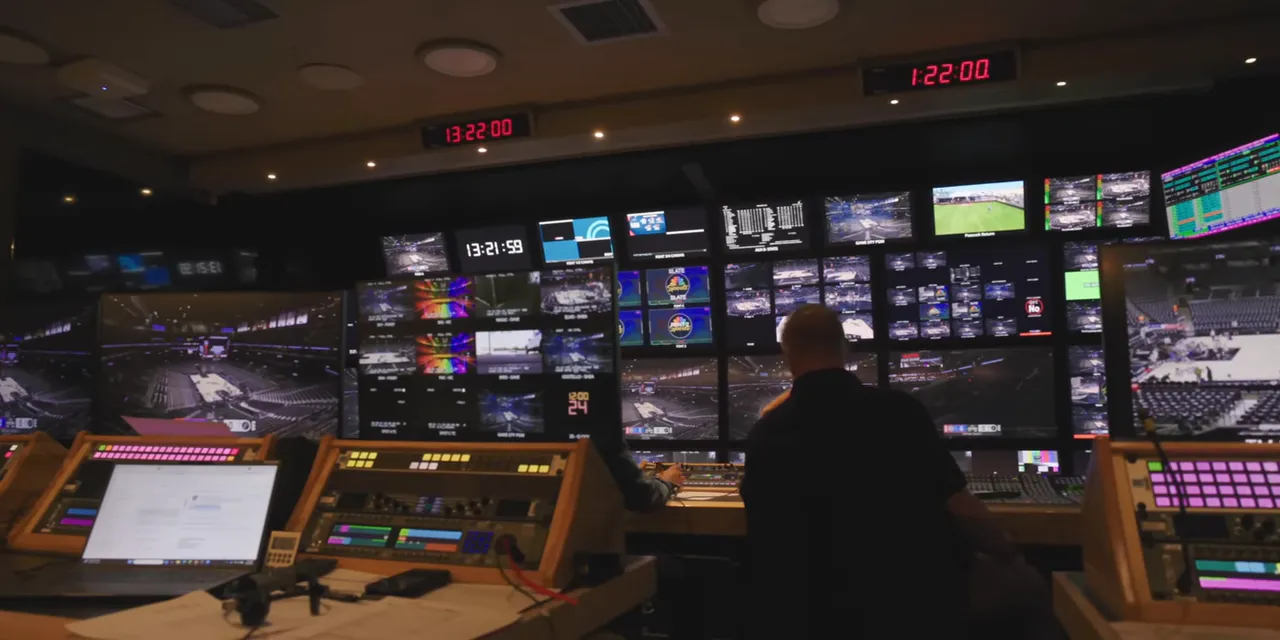
This is where all the sources converge: main game cameras, backboard cameras, above-the-rim cameras, Steadicam, slow-motion cameras, the flying cable camera, and the microphones.
Then it all gets cut together in real time.
That is the part worth sitting with. A team is taking the action on the court, interviews, commentary, crowd reactions, and everything happening around the game, then turning it into a finished, unscripted production as it unfolds.
A movie can spend months in production and more months in post-production getting the images, sound, and pacing right. Here, the 48 minutes of basketball action are being shaped into a finished multicamera experience live, along with everything surrounding those minutes.
Several Jobs Happen at Once
Inside the trucks, different people are constantly managing different parts of that finished result:
- Camera matching: Engineers white-balance and adjust cameras so their colors match when the broadcast cuts between them.
- Live audio mixing: Dozens of microphones have to become a balanced mix that preserves both clear commentary and the intensity of the arena.
- Framing and image adjustments: Operators crop, reframe, and adjust zoom moves to highlight smaller details within larger images.
- Directing: The director monitors the available feeds, talks to camera operators, and calls which source should go live next.
It is not just a collection of good shots. It is a team deciding which shot matters right now, making sure it looks and sounds right, and getting it on air at the correct moment.
How Slow-Motion Replays Arrive So Quickly
One piece of gear that kept appearing throughout these setups was a replay controller made by EVS. It has a wheel on the right, a smooth lever on the left, and a lot of versatility.
One of the trucks is dedicated to replay. It continuously receives camera feeds, so operators can find and prepare a moment almost immediately after it happens.
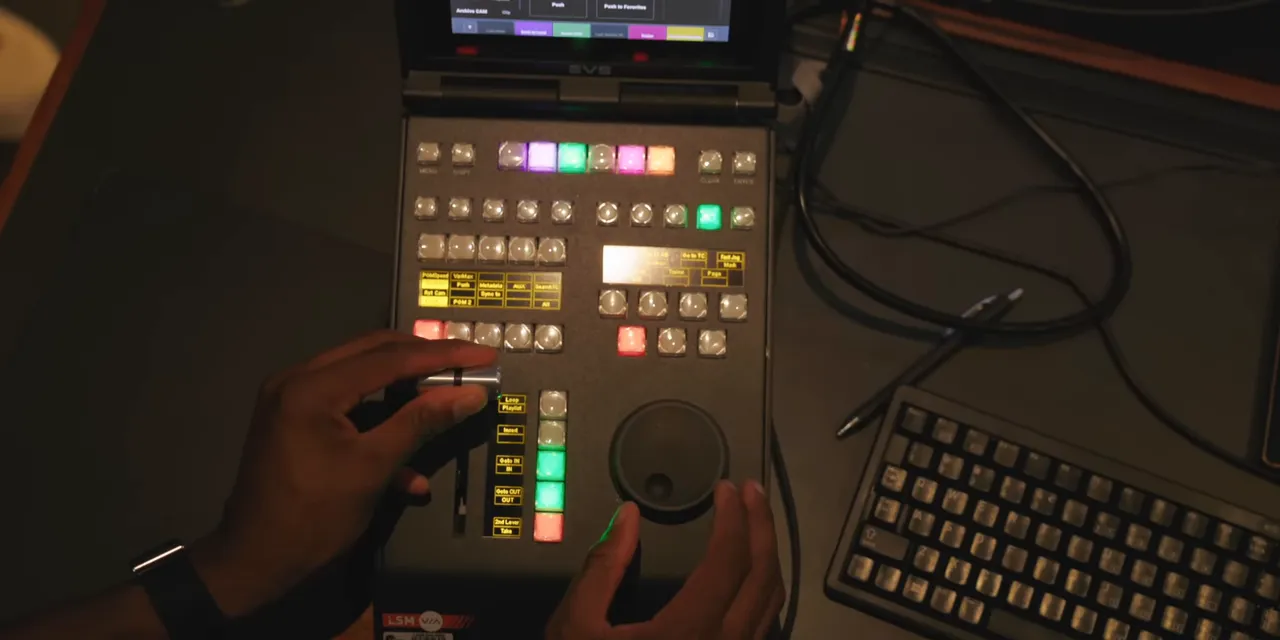
The workflow is wonderfully tactile:
- Find the moment. The wheel scrubs backward or forward through the footage.
- Cue the clip. The operator positions the footage at the intended starting point.
- Wait for the director’s call. The replay needs to fit the live broadcast, not just be ready.
- Control the speed. The lever smoothly adjusts playback from full speed down through slow motion, all the way to a stop.
The source footage is often captured at up to 180 frames per second, giving the operator the material for those crisp slow-motion replays.
That is how a play can happen, then return seconds later as a carefully timed replay with the speed changing smoothly around the important moment.
Again, the controls make immediate sense when you try them. Getting the timing, clip selection, and playback exactly right during a live game is a different level of skill.
The Best Broadcast Technology Disappears
Getting hands-on with this equipment gave me a much bigger appreciation for how different live sports production is from what I do.
The giant lenses are impressive. So are the cable camera, the hidden microphones, and the replay controllers. But none of those pieces works in isolation. The finished broadcast depends on camera operators, engineers, audio teams, replay operators, and the director coordinating continuously.
It is live storytelling on a huge stage, delivered to millions of people with no chance to go back and redo the play.
And the funny thing is, when everyone does their job really, really well, you barely think about any of it. You just get the game.


