Cars have gotten smoother, quieter, and more aerodynamically efficient. A lot of them have also started looking like slightly different versions of the same blob. It’s enough to make you wonder what happened to the ridiculous supercars you wanted on your bedroom wall as a kid.
Then something like the McLaren W1 shows up.
This is the successor to the F1 and the P1. That is a wildly intimidating family tree. The F1’s 240 mph top speed still makes it the benchmark for naturally aspirated performance. The P1, one of the original holy trinity of hybrid supercars, has been my favorite car of all time. I’ve driven one, and I get why people with garages full of incredible cars still call it their favorite.
Now I’ve spent about three hours behind the wheel of the W1, between Italian mountain roads and Mugello Circuit. And I think I have a new poster car.
Quick Summary
- The W1 combines more than 1,200 horsepower with low weight, rear-wheel drive, and hydraulic steering.
- Its small hybrid battery prioritizes immediate response and torque fill rather than meaningful electric-only range.
- Comfort mode delivers surprising road usability, while Race mode transforms the suspension and active aerodynamics.
- Prototype faults leave reliability questions, despite encouraging cabin materials and perceived build quality.
Table of Contents
- More Than Another 1,200-Horsepower Hybrid
- The Bodywork Is Really an Air-Management System
- McLaren’s Most Interesting Interior Yet
- On the Road, Comfort Mode Is Actually Comfortable
- The Hybrid System Is About Response, Not Electric Range
- Race Mode at Mugello Is a Different Experience
- The Verdict: A New Poster Car, With Some Real Caveats
More Than Another 1,200-Horsepower Hybrid
Electrification arriving in supercars was never really a question. The hybrid holy trinity of the mid-2010s was the beginning, not the endpoint. But today, announcing another hybrid with four-digit horsepower almost feels normal.
So what makes this one special?
For me, it starts with the things McLaren refuses to give up: low weight, rear-wheel drive, hydraulic steering, and a serious focus on the person driving. There’s even 3D-printed, aerodynamically shaped double-wishbone suspension. This is not just an enormous powertrain wrapped in expensive bodywork.
If the only question is straight-line acceleration, the all-electric, all-wheel-drive Rimac Nevera I drove is still faster. Instant electric torque and that kind of traction are hard to beat.
But straight-line speed is not the whole story. The W1 is built to be an incredibly capable track machine that can still function as a car on the road. Its powertrain, aerodynamics, and chassis all work toward that combination. It feels closer than ever to McLaren’s interpretation of a Formula One car with a license plate.

The Bodywork Is Really an Air-Management System
The W1 looks amazing. But the more interesting part is how much of that shape exists to do something useful.
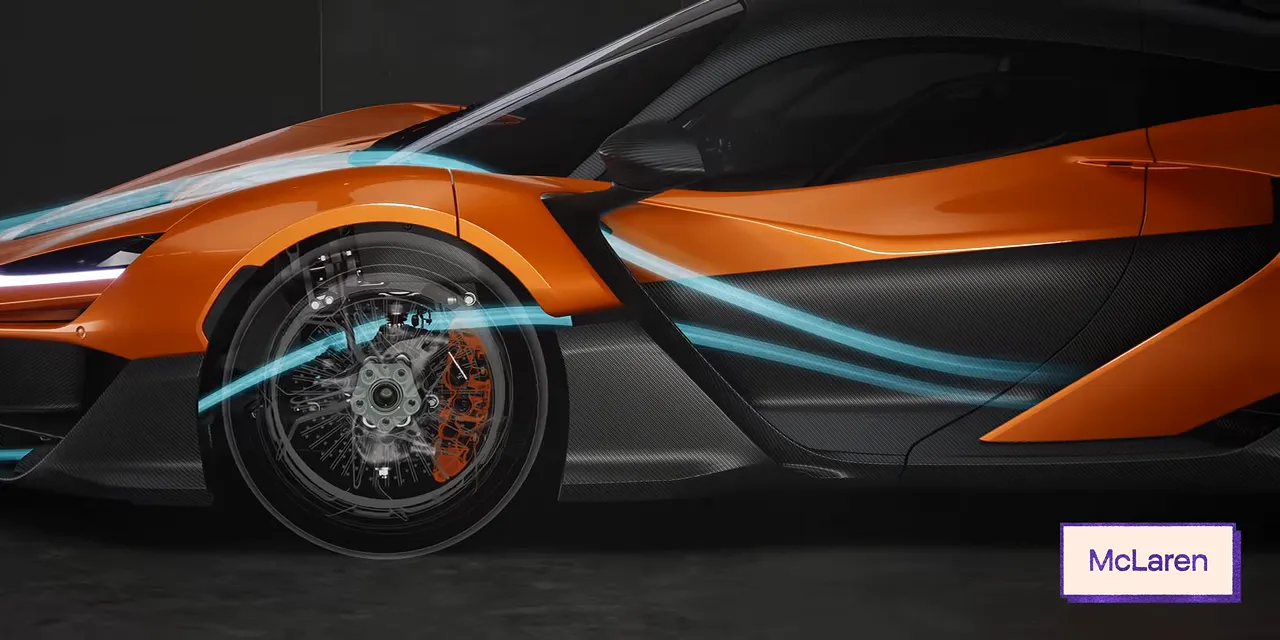
From the front splitter to the rear diffuser, the entire car is organized around controlling airflow. The surfaces aren’t just sculpted to look fast. They guide air over, through, around, and underneath the car.
It starts at the nose
There’s an active element at the very front. The front splitter moves up and down, changing its position as part of the car’s drag-reduction and aerodynamic management.
Air entering the front cooling opening passes through the radiator and exits over the hood. That exit flow helps manage the air traveling across the top of the car, keeping it attached to the bodywork rather than simply letting it spill wherever it wants.
Then there are the sides. Air gets pulled into channels around the front wheel area and routed toward the huge side inlets. Calling the doors solid panels almost feels generous. They’re practically a collection of openings with a door built around them.
That roof element is not a scoop
The raised piece above the cabin looks like it could be a roof scoop, especially if you remember the P1. It isn’t. Its job is to keep air moving cleanly across the top of the car.
At the back, the active rear wing works with an enormous diffuser to complete the ground-effect package. McLaren’s explanation is that air exits the rear of the car at roughly twice the speed it entered at the front.
That’s the cool thing about this design. It still delivers the drama you want from a poster car, but there’s a clear engineering reason behind so much of it. And somehow, after all those channels, holes, and moving parts, the exhaust and rear end still look really good.
McLaren’s Most Interesting Interior Yet
McLaren interiors have improved a lot over the years. Historically, the big concerns have been build quality and reliability, not whether the cars were fast enough.
The W1’s cabin is easily the most interesting interior I’ve experienced from the company. The materials, shapes, and little mechanical details all feel like they belong in something this special.
The seats are integrated into the carbon-fiber structure. You’re essentially sitting inside the tub, surrounded by this unusual knit material that looks like something from a CES concept car. It’s used throughout the cabin, including over some of the Bowers & Wilkins speakers, where it needs to let sound pass through.
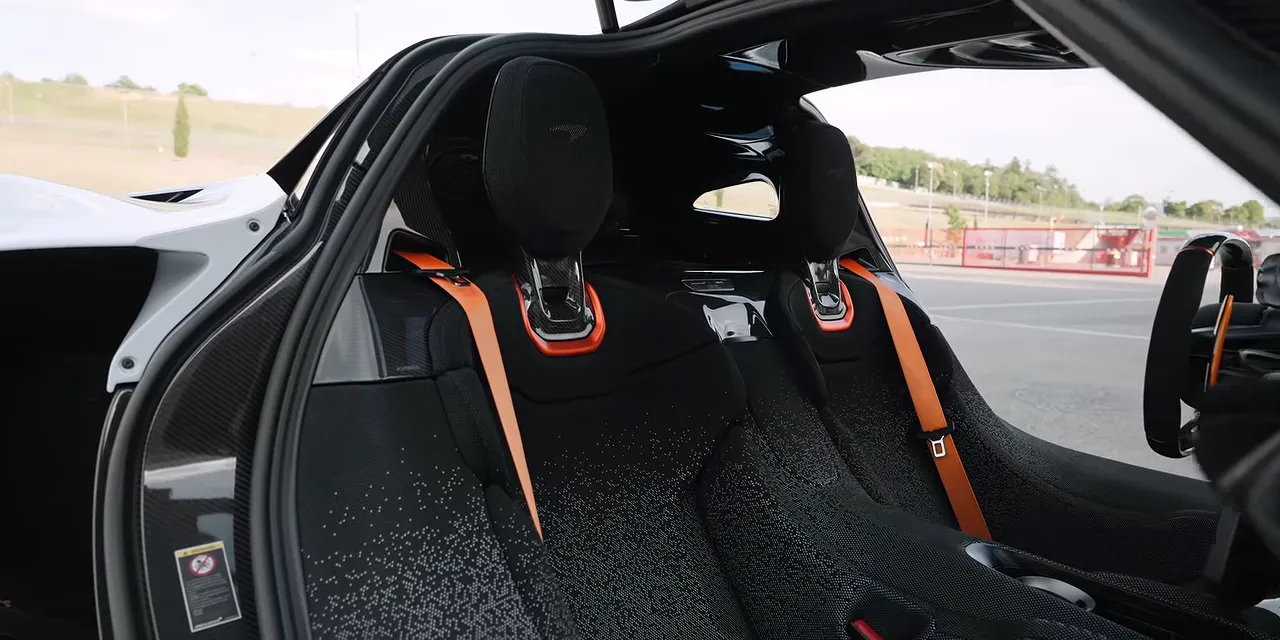
There are carbon-fiber air-conditioning ducts, big carbon-fiber paddle shifters, a small glass section in the roof, and absurdly thin carbon-fiber sun visors. They look like McLaren used exactly as much material as necessary to make a sun visor count as a sun visor. But they work.
Even the door handle is a nice detail. You’re holding a sculpted piece of carbon fiber, and that same piece is where you release the door. Small LEDs add another layer to the cabin, which I imagine looks even better at night.
The controls come to you
Because the seats don’t slide, adjusting the driving position works differently. Pull a latch and move the pedals toward or away from you, then position the steering wheel where you want it.
That reversal takes a second to get used to. You’re not moving yourself around the car. You’re moving the car’s controls around you.
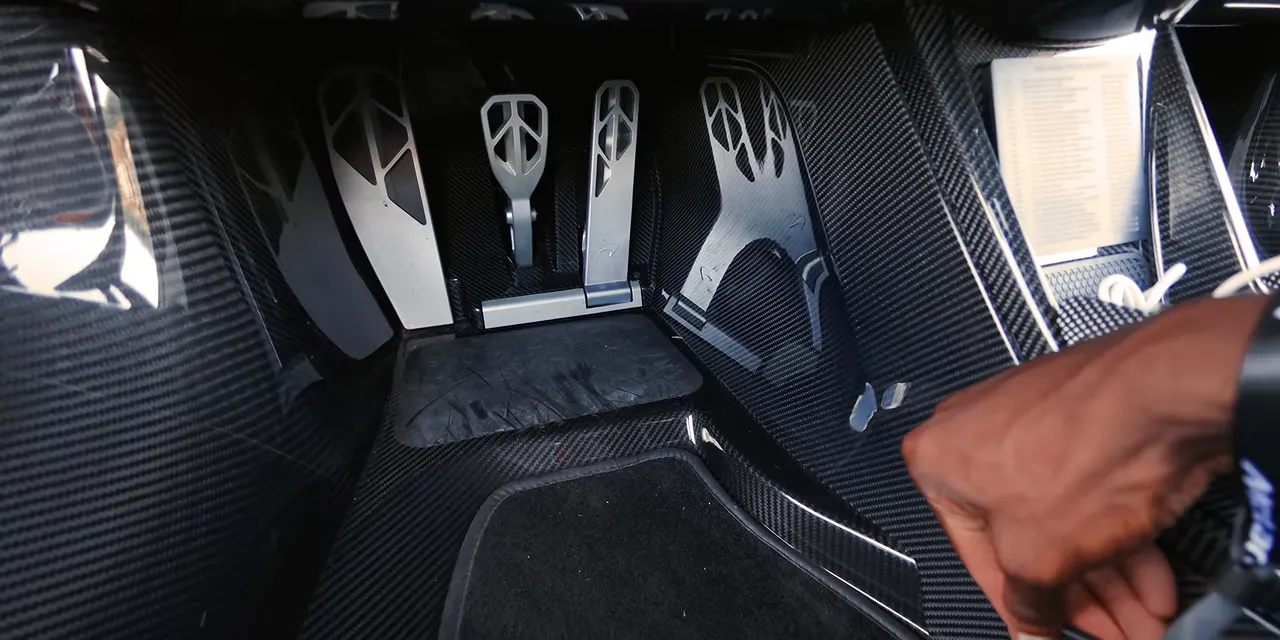
The instrument binnacle moves with the steering wheel, similar to the setup in other modern McLarens, including the Artura. Suspension controls sit on the left, and powertrain controls sit on the right. Both are right there within easy reach.
A floating center display includes wired Apple CarPlay. That’s not the main reason you buy a W1, obviously, but I appreciate that it’s there.
Yes, there are two cup holders
For something this track-focused, there are a surprising number of concessions to normal use:
- A dedicated spot for the key that slides back to expose another cup holder.
- Two cup holders in total. Very practical. Relatively speaking.
- A storage area behind the occupants, accessible through the rear cabin section, with room for roughly a duffel bag and a backpack.
- A fire extinguisher tucked into the cabin.
- A camera-based rearview mirror, which is essential because there’s essentially no useful direct view out the back.
The funny part about that rear camera is that the wing takes up roughly the bottom quarter of the image. I actually like that. You can see it moving around as you drive, which is a pretty good reminder of what you’re in.
On the Road, Comfort Mode Is Actually Comfortable
The engine-start control is in the roof. Start it up, leave the car in Comfort, and the first surprise is how normal some of the experience can feel.
You’re very low to the ground, of course. But on the tight Italian mountain roads where I drove it, the W1 absorbed potholes impressively well. These weren’t perfectly smooth roads, and the car wasn’t constantly punishing me for that.
It also wasn’t overwhelmingly loud. The accelerator wasn’t twitchy. The hybrid system made low-rpm response feel immediate without turning every tiny pedal movement into an event.
Forward and side visibility are good, too. There’s a big windshield and a huge side window. Only the lower portion of that split side window opens, but that’s enough for tolls or waving to someone.
Rear visibility is entirely a camera situation, complete with that wing photobombing the image. Overall, I’d give visibility a B+ for this type of car.
The width is harder to ignore. On narrow roads, you’re aware of how much car is around you every time you turn.
The steering is the standout
You do not need to drive quickly to appreciate the hydraulic steering. The feedback is there at ordinary speeds.
In my opinion, McLaren continues to make the best steering in the supercar world. There’s a directness and communication that makes even a relatively restrained road drive interesting. That matters in a car whose full performance is so far beyond what you can reasonably explore on the street.
This is also where the lightweight philosophy comes through. The W1 has an incredibly complicated job to do, but it hasn’t abandoned the things that make a car satisfying before you reach an outrageous speed.
The Hybrid System Is About Response, Not Electric Range
The battery is only 1.4 kWh. That is tiny, and it tells you a lot about the priorities here.
You can travel roughly one to two miles on electric power before the engine needs to join in. But electric-only driving is not the point. The point is torque fill: using the electric motor to deliver acceleration immediately while the combustion engine’s turbos build boost.
The radial-flux electric motor draws on Formula E technology, and the electrical side of this car is remarkably power-dense.
Here are the numbers that matter:
- Engine: A new, in-house 4.0-liter twin-turbo V8 with a flat-plane crank, producing more than 900 horsepower on its own.
- Electric assistance: Another 342 horsepower from the electrical system.
- Combined output: More than 1,200 horsepower.
- Quoted dry weight: 1,399 kg.
- Claimed acceleration: Zero to 186 mph in 12.7 seconds.
That dry-weight number needs context. It is not a fully fueled, ready-to-drive weight. During my comparison, I used roughly 1,450 kg as an illustrative estimate after adding fuel, not as a measured or official running weight. That would still put it below about 3,200 pounds.
For perspective, my benchmark for a really fast car is the latest Porsche 911 Turbo S. Its engine makes roughly 630 horsepower, with electrical assistance bringing peak combined output to about 700 horsepower. It weighs around 1,700 kg, and its zero-to-186 mph time is about 22 seconds.
That Porsche is seriously fast. The W1 reaching the same speed in 12.7 seconds puts the two in completely different performance leagues.
The horsepower is ridiculous. The horsepower combined with the low weight is the really ridiculous part. McLaren’s official W1 overview gives more context on the car’s powertrain and aerodynamic engineering.
Sport mode brings out another personality
Switch both the powertrain and suspension into Sport, and everything sharpens up. The ride stiffens, the shifts become more aggressive, the accelerator responds more eagerly, and the sound starts to come alive.
Beyond the engine itself, the most noticeable sound is the turbo flutter and blow-off noise. There’s a lot happening behind you.
Compared with the 750S, the acceleration feels like these longer, sustained pulls, with the hybrid system filling in torque all the way through the rev range. Second gear just keeps delivering.
The transmission has eight forward gears. There is no mechanical reverse gear; reversing is handled electrically.
And this is where the W1 becomes an interesting contradiction. It participates in the modern hypercar arms race, with enormous power and capability that can feel less emotional than older cars. But it also retains low weight, rear-wheel drive, and wonderfully communicative steering.
It’s both things at once. The tech hasn’t erased the driving experience, even if it has changed it.
Race Mode at Mugello Is a Different Experience
You cannot understand everything this car can do on a public road. For that, McLaren reserved Mugello Circuit for the day.
Mugello has 15 turns, fast direction changes, elevation changes, and a roughly one-kilometer start-finish straight. It hosted the Tuscan Grand Prix in 2020, so this is a proper Formula One venue, with the smooth surface and space to explore a car like this.
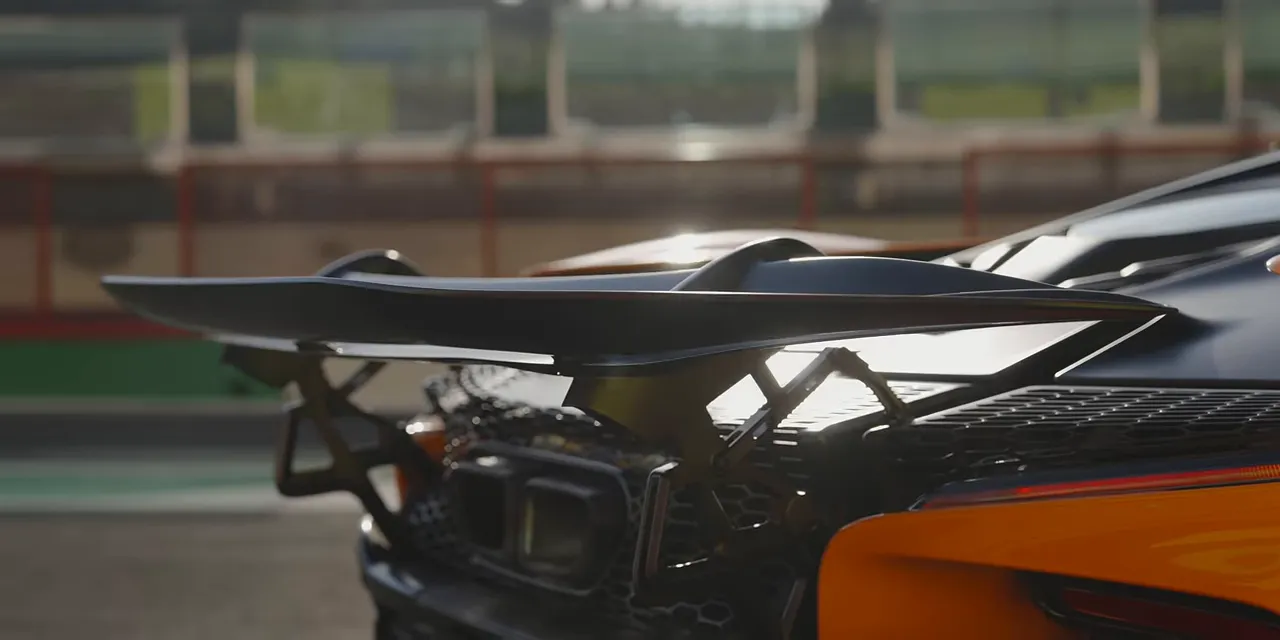
Race mode changes the W1 physically. The suspension drops, and the rear wing extends backward by almost a foot. It reaches so far behind the car that it effectively becomes an extension of the rear diffuser.
That fully extended configuration is for the circuit, not the street, because the wing projects beyond the rear bumper. At Mugello, that wasn’t a problem.
What followed was the kind of experience you hope a car like this can deliver: full throttle, huge grip through high-speed corners, and enough power that pressing the steering-wheel boost button still produces a very noticeable extra kick.
The guidance from the passenger seat was about trusting the aero and the grip, allowing the car to use the track, and straightening the line where possible. The W1 stayed incredibly planted on its Trofeo RS tires.
It was so intense that some of the footage from later laps became unusable. The cornering forces physically shifted glass inside the camera lens and knocked the image out of focus. That’s a pretty unusual camera problem to have.
Over 190 mph, then the braking zone
At the end of the main straight, I was reaching more than 190 mph.
That’s around the speed Lewis Hamilton reached there on his way to winning the 2020 Tuscan Grand Prix. To be clear, matching a speed at one point on a straight is not the same as matching a Formula One car’s lap performance. But it is still an absurd reference point for something that can leave the circuit and drive on the road.
The only place I really felt the rear get a little loose was under the biggest braking demand of the lap: standing on the carbon-ceramic brakes from around 190 mph into Turn One. The back moved slightly, then the car carried on doing its thing.
Everywhere else, the combination of aero and tires made it feel locked to the surface. There is so much capability here that three hours split between road and track can only reveal part of it.
The Verdict: A New Poster Car, With Some Real Caveats
My two biggest highlights are the design and the range of personalities.
The anhedral doors, the cabin materials, the carbon-fiber details, and the overall aesthetic make this feel genuinely special. More importantly, it can shift from something surprisingly comfortable, with enough storage for a small trip, into an aerodynamic track monster.
At this price, that breadth is something you should expect. It’s still impressive to experience it working.
There are caveats. The car I drove was a prototype, not a finished production example. It did throw faults during the day, and there were some odd door-latch issues.
I’m willing to give a prototype some room on those things. I’m not willing to pretend they didn’t happen. A highly complex hybrid also leaves legitimate long-term reliability questions that a single day of driving cannot answer.
That said, the perceived build quality was encouraging. McLaren seems to have made real progress in the areas that have historically drawn criticism, and I came away optimistic rather than dismissive.
The car it reminds me of most is still the P1. The sound, the outrageous power, and especially the near-absence of turbo lag all bring that connection back.
In other powerful, lightweight turbocharged cars, you can still feel the moment when the engine is gathering itself. Here, you hear it spool up while the electric motor has already started accelerating you. The gap is essentially filled in. It’s awesome.
Only 399 McLaren W1s are being built, at more than $2 million each. Like the P1, it is going to be an extraordinarily rare thing to encounter on the road. I may never come across one again.
But after a day of narrow roads, hydraulic steering, moving aero, and full-throttle laps at Mugello, this is the best car I’ve ever driven. Not simply because it’s fast. Because it makes all that technology feel like something worth being excited about.
The bedroom-wall supercar is very much still here.


