Samsung has three new folding phones, and the order of interestingness is not what the names would suggest: Galaxy Z Flip 8, Galaxy Z Fold 8 Ultra, and then the regular Galaxy Z Fold 8.
Yes, the smaller, non-Ultra Fold is the one that surprised me most.
The Flip gets the predictable refinements. The big Fold gets some genuinely welcome hardware upgrades and a new Ultra name. But the new, wider Fold 8 brings back a shape the industry seemed to have moved away from. And the more time I spent holding it, opening it, and using it, the more it made sense.
There is some clever product positioning happening here. There is also a legitimately nice phone underneath it. Unfortunately, everything is more expensive.
Quick Summary
- The Galaxy Z Flip 8 brings modest refinements rather than a compelling upgrade for recent owners.
- The Fold 8 Ultra significantly reduces its crease and adds a larger battery with faster charging.
- The smaller Fold 8’s light hardware and 4:3 display make it surprisingly appealing for photos and reading.
- Higher starting prices make long-term testing essential before judging whether these foldables justify their cost.
Galaxy Z Flip 8: Slow and Steady
The Galaxy Z Flip 8 looks a lot like the Flip 7. It is a little thinner and a little lighter, but this is very much a safe, incremental update.
It gets the Snapdragon 8 Elite Gen 5 for Galaxy, matching the S26 series, along with the chip’s performance, image processing pipeline, and NPU. Samsung has also beveled the inner edges slightly, which makes getting the phone open a bit easier.
The cover screen behaves more like a regular phone screen now:
- Swipe down from the left for notifications.
- Swipe down from the right for quick settings.
- Swipe up from the bottom to get to your apps.
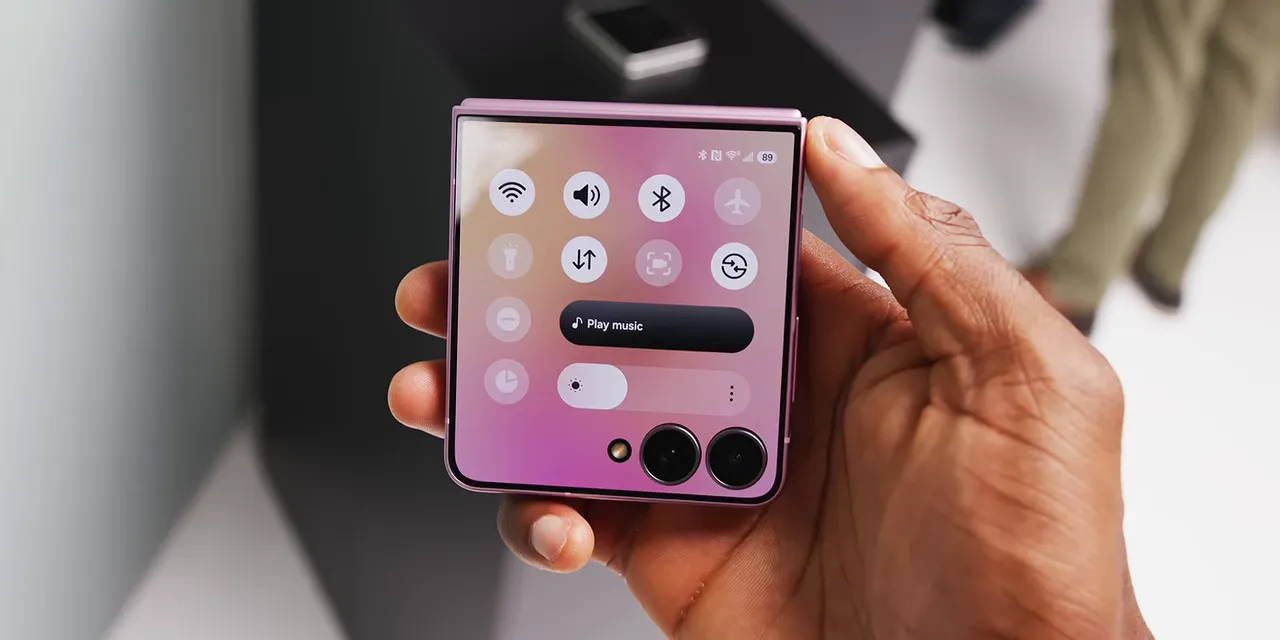
That is all fine. These are useful little improvements. But is being eight grams lighter and half a millimeter thinner going to make a meaningful difference to someone with last year’s Flip, or even the one before it? Not really.
This is Samsung’s familiar slow-and-steady approach. A slightly better version of a phone we already know.
Galaxy Z Fold 8 Ultra: The Familiar Fold Gets Better Hardware
The eighth generation of Samsung’s big book-style foldable is now called the Galaxy Z Fold 8 Ultra. The reason for the name change becomes clearer once you see the smaller Fold, but first, there are some real improvements here.
Samsung helped establish this category, yet its gradual updates have allowed more aggressive competitors to catch up and, in some areas, move ahead. This generation still follows the incremental formula, but it addresses a few things that needed attention.
There is a new Snapdragon chip. It is slightly thinner and lighter. The ultrawide camera moves to a new 50-megapixel sensor and can now record 8K video. That sits alongside the same 200-megapixel main camera as last year, while the telephoto camera is unchanged.
The Crease Is Much Less Obvious
The biggest upgrade is the hinge and inner display.
The Oppo Find N6 had already shown how close a folding screen could get to eliminating a visible crease. That left Samsung looking a little behind. Now, with a titanium alloy film behind the OLED and a titanium backplate, Samsung has made a substantial improvement of its own.
It is not quite at Oppo’s level. On my completely subjective crease scale, if Oppo is a 10 out of 10, this is around an eight or eight and a half. Last year’s Samsung would have been closer to a five.
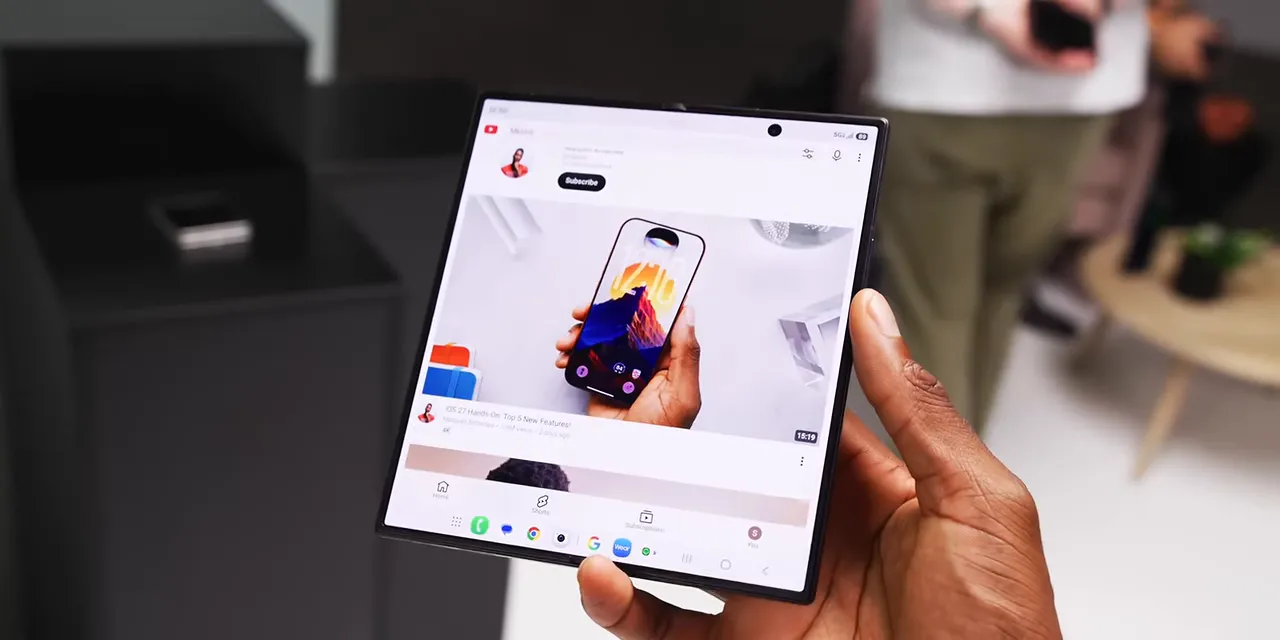
That is a big jump. Turn the display on and put actual content on it, and there is very little crease to notice. The new anti-reflective coating and 3,000-nit maximum brightness help make the display feel more convincing, too.
A Bigger Battery and Faster Charging, Finally
Samsung is also starting to use some silicon in its batteries. It is not going nearly as far as Oppo or some of the other more aggressive foldable makers, which probably should not be surprising given Samsung’s battery history.
Still, the result is the largest battery Samsung has put in a Fold so far, at 5,000mAh. Charging finally gets an upgrade as well:
- Wired charging: 45W, up from 25W.
- Wireless charging: 20W, up from 15W.
Those are welcome changes. They are not a substitute for testing actual battery life, but they are meaningful hardware improvements rather than just another new processor.
Why the Smaller Fold Exists, and Why the Big One Is Now Ultra
Here is where Samsung’s lineup gets interesting.
The expectation is that Apple will introduce its first folding iPhone in a few months. The rumored shape is shorter, wider, and more passport-like than Samsung’s familiar tall Fold. That is still an expectation, not an announced Apple product or a confirmed design.
But this shape is not new. The original Oppo Find N and the first-generation Pixel Fold both explored it. Then much of the industry moved toward something closer to Samsung’s current approach: a fairly normal, slightly tall phone when closed that unfolds into a big, almost square display.
Samsung is now bringing the passport shape back, and it is placing that phone below its larger Fold.
So the established, taller design becomes the Z Fold 8 Ultra. The new smaller, wider design is simply the Z Fold 8.
My read is that this gives Samsung a pretty convenient response if Apple arrives with a similar shape: we already make one of those, and we also have the Ultra above it. That does not automatically make the Ultra better for everyone, but as positioning, it is clever.
Galaxy Z Fold 8 Wide: The Hardware Is the Surprise
Put the strategy aside, though, because the smaller Fold is genuinely interesting to hold.
It shares the important new display hardware with the Ultra: the titanium flex hinge, the much less noticeable crease, and the anti-reflective coating. There is some silicon in its battery, too. But the whole device is noticeably smaller, shorter, thin, and light.
It weighs 201 grams, about the same as a Galaxy S26 Plus. Except this has an outside display, an inner folding display, and a 4,500mAh battery.
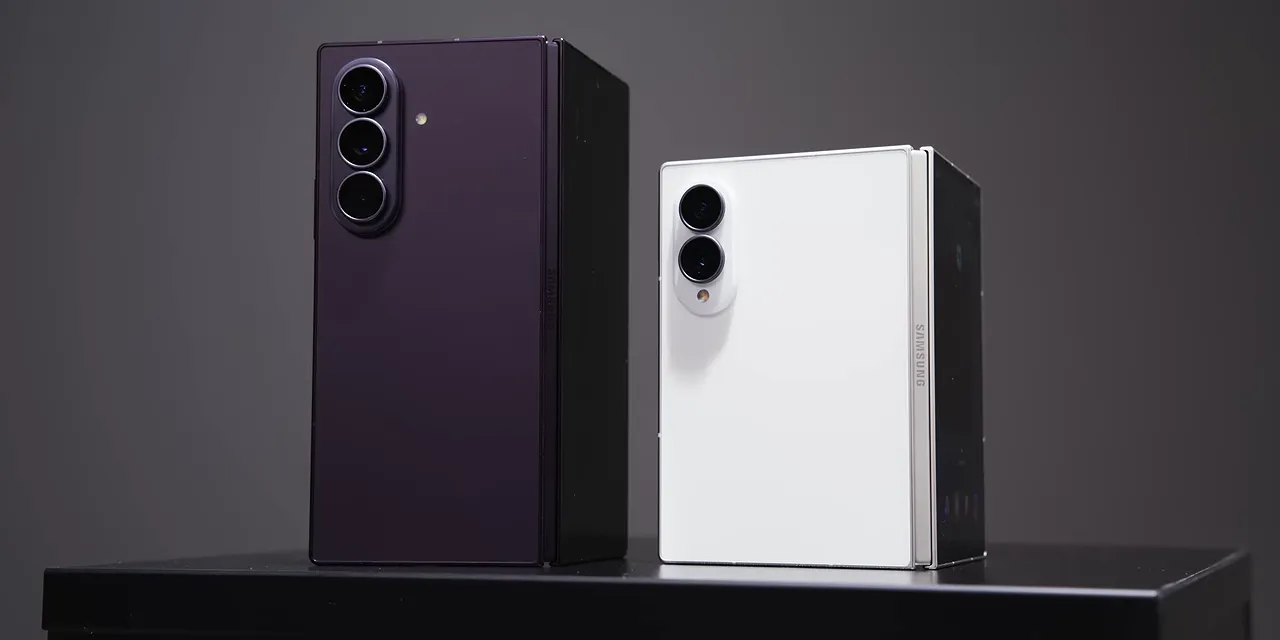
And let me cook here: it reminds me of the good parts of the Surface Duo. Specifically, the really nice hardware parts. That thin, short, book-like object that feels unusually good in your hands.
The more I used it, the more I liked it. I did not expect that coming in.
It is clearly less phone than the Ultra in several measurable ways. There is less screen, less battery, and one fewer rear camera. But smaller does not necessarily mean worse. Sometimes it means the device is better suited to what you actually want to do.
Fold 8 vs. Fold 8 Ultra: Multitasking or Media?
The easiest way to understand these two Folds is through their displays.
- Galaxy Z Fold 8: A 5.5-inch cover screen with a 10:16 aspect ratio and thin bezels, plus a 7.6-inch inner screen with a 4:3 aspect ratio and 3,000-nit maximum brightness.
- Galaxy Z Fold 8 Ultra: The taller closed-phone shape and a larger, 8-inch inner display, with more room for multiple apps.
The Ultra is the power-user Fold. That big inner screen is effectively two phones beside each other, which is exactly why it has always been good at running apps side by side.
The smaller Fold has the same core processing power on paper, but its screen size and shape make it a little less ideal for multitasking. It can still do it. There is simply less room to work.
What you get instead is a device that feels better suited to certain media-related activities.
A More Reachable Camera
Using the camera while the Fold 8 is closed is a good example. The shorter cover screen puts the controls within easier thumb reach, and the image you are framing fills more of the display. That feels better than the taller candybar-style Fold.
The camera hardware is a step down from the Ultra, though. The smaller Fold has a 50-megapixel main camera and an ultrawide, rather than the Ultra’s 200-megapixel main camera and three-camera setup. There is no dedicated telephoto here.
So this is not a claim that the smaller phone takes better pictures. It is that the shape makes taking them feel nicer.
Photos Fit the Inner Screen Beautifully
Open the Fold 8 to review your pictures, and the 4:3 display makes immediate sense. Photos are often 4:3 themselves, so they can fill the screen instead of sitting inside a differently shaped canvas.
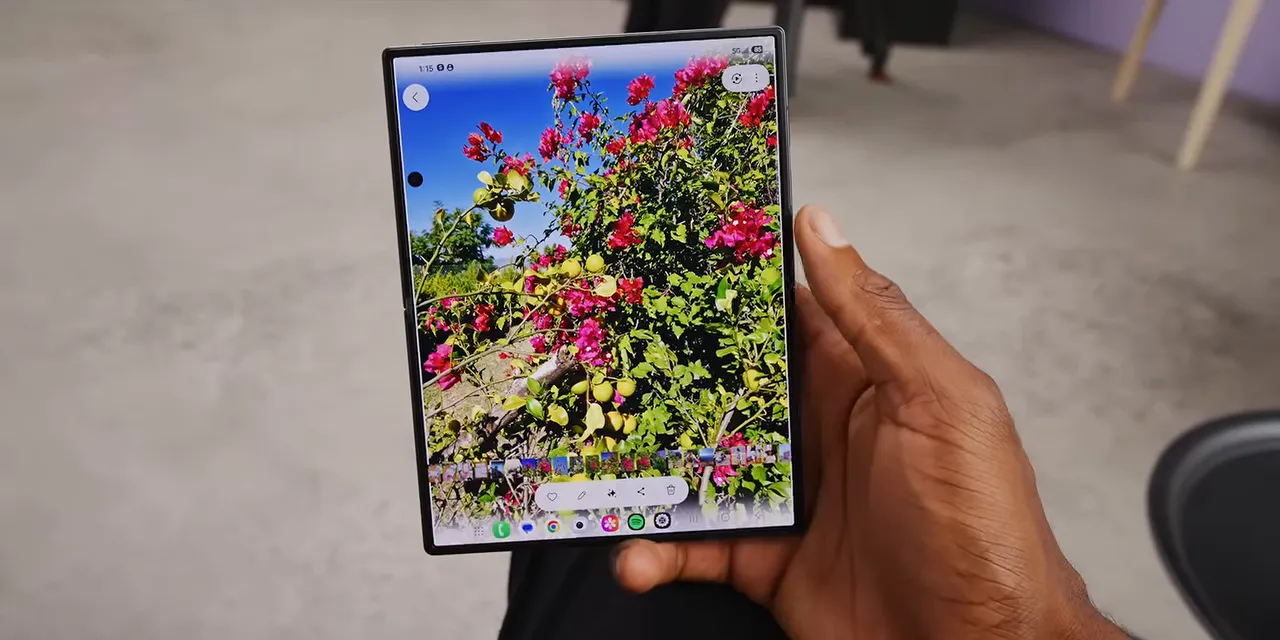
It is one of those small differences that makes the device feel more purposeful. The screen is not just smaller. Its proportions work better for this particular job.
A Promising Reading Device, With a Video Caveat
I also think this form factor could make a great e-reader, open or closed. The low weight is a big part of that appeal. A folding phone becomes much more interesting for reading when holding it does not feel like holding a brick.
Widescreen video is not a perfect match, of course. There will still be black bars. A 4:3 display does not magically make every kind of content fit.
But overall, this is a really nice size in the hand, both open and closed. The Ultra offers more workspace. The regular Fold offers a shape I increasingly want to pick up.
The Catch: All Three Phones Cost More
The smaller Fold sits logically between the Flip and the Ultra. Fewer cameras, smaller displays, a smaller battery, and a lower price than the Ultra. That all makes sense.
The “lower price” part just does not hit quite as hard when the whole lineup is this expensive.
All three start with 256GB of storage. Starting prices are roughly:
- Galaxy Z Flip 8: $1,200.
- Galaxy Z Fold 8: $1,900.
- Galaxy Z Fold 8 Ultra: Over $2,000.
The Ultra is about $100 more than last year’s big Fold, and crossing that $2,000 starting-price line adds some real sticker shock.
With memory prices increasing, I would not be surprised to see more devices arrive at higher prices over the next few months. I also expect a folding iPhone to be expensive, although its actual price remains unknown.
So these are first impressions, not a final value judgment. The Ultra’s display and battery changes are welcome. The Flip is another steady refinement. But the smaller Fold is the one that has me thinking I could actually use it as my everyday phone.
That is the surprise: the Fold with less hardware may be the Fold I prefer. Whether it earns that price is a question for longer-term testing.
Sponsor: Protecting an Expensive Fold
With phones this expensive, a case is worth thinking about. Sponsor dbrand has Grip cases for all three models: the Galaxy Z Flip 8, Z Fold 8, and Z Fold 8 Ultra.
The folding Grip cases include a magnetic hinge cover that moves with the phone as it opens and closes, protecting the folding mechanism in either position. dbrand also offers screen protectors with an installer tray designed to align the protector and simplify installation.
The company participated in Samsung’s official accessory program, giving it an early start on development and compatibility testing alongside Samsung.
|


