Well, well, well. Techtember is back, and Apple’s fall iPhone lineup looks a little different this time.
There’s a new iPhone 18 Pro, a new Pro Max, and the folding iPhone that has been a long time coming. The base iPhone is moving to early next year, probably alongside the next Air and SE. Welcome to the new cycle.
The Pro phones are familiar on the outside, with some potentially meaningful changes inside. But the genuinely interesting one is the iPhone Duo: a passport-shaped foldable that feels surprisingly polished for Apple’s first attempt at this form factor.
After a couple of hours with it, my biggest takeaway isn’t about megapixels or raw horsepower. It’s how a bunch of tiny, arguably unnecessary details add up to a phone that’s really fun to use. There are also some pretty obvious downsides. So, first impressions, not a final verdict.
Quick Summary
- The iPhone 18 Pro adds variable aperture and ambitious battery claims, but meaningful gains still need testing.
- The iPhone Duo combines compact phone use with a 7.6-inch inner display and two-app multitasking.
- The Duo’s standout strengths are its low-reflection display, fast screen transitions, and thoughtful usability details.
- A weak inner selfie camera, right-handed interface, and $2,000 starting price are significant trade-offs.
Table of Contents
- iPhone 18 Pro: Familiar Design, Upgrades That Need Testing
- iPhone Duo: An iPhone Closed, an iPad Mini Open
- The Inner Display Is the Hardware Highlight
- The Software Feels Like iOS With a Little Extra Sauce
- iPhone Duo vs. Galaxy Z Fold 8: Similar Function, Different Feel
- The iPhone Duo’s Downsides Are Real
- Price, Release Timing, and Who This Is For
- The Other Announcements
- Sponsored: Ridge Accessories
iPhone 18 Pro: Familiar Design, Upgrades That Need Testing
The iPhone 18 Pro and Pro Max look essentially the same as before. Same sizes, same overall designs, same fundamentals. Most of what’s new will require actual testing before I can say whether it makes a meaningful difference.
A20 Pro and the battery life promises
Inside is the new A20 Pro, built on a 2-nanometer process, with 50% more memory bandwidth. Those are promising numbers. How much faster does the phone feel? How much more efficient is it? That’s still to be determined.
The battery claims are more immediately interesting:
- iPhone 18 Pro: Apple says it matches the battery life of the iPhone 17 Pro Max.
- iPhone 18 Pro Max: Apple claims the best battery life ever in an iPhone.
You’d hope battery life improves every year, but the capacities don’t appear dramatically different. If those claims hold up, the efficiency gains could be doing some real work.
A main camera with a physical variable aperture
The main camera now has a variable aperture with manual control. Instead of keeping the lens wide open all the time, you can choose between four aperture settings in the camera app.
And yes, Samsung did something related eight years ago with the Galaxy S9. That phone switched between two settings, f/1.5 and f/2.4. This is four, and you can actually see the physical aperture blades opening and closing if you get enough light onto the lens.
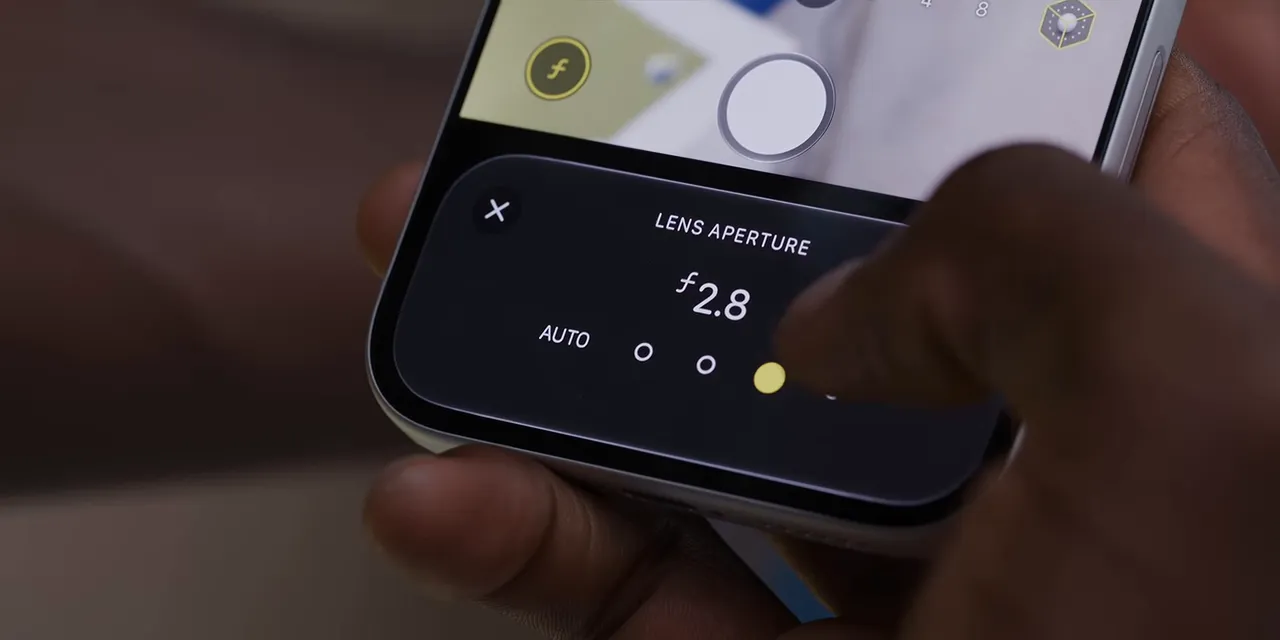
The other difference is sensor size. Apple is working with a much larger sensor than Samsung had in the S9, so there’s potentially more of a visible difference between shooting wide open and stopping down. For some background on the underlying concept, aperture describes the lens opening that controls how much light passes through.
Whether this becomes a genuinely useful creative control or a feature most people leave on automatic needs testing. But I appreciate new camera hardware. This deserves a chance.
A smaller Dynamic Island and better color choices
The Dynamic Island is 25% smaller. Apple has moved the Face ID infrared camera behind the display in the upper-left corner, where there’s a slightly different pixel matrix. With the naked eye, you basically can’t tell it’s there most of the time.
The smaller central cutout also leaves room for up to three Live Activities instead of two. A small improvement, but a welcome one.
Then there are the colors:
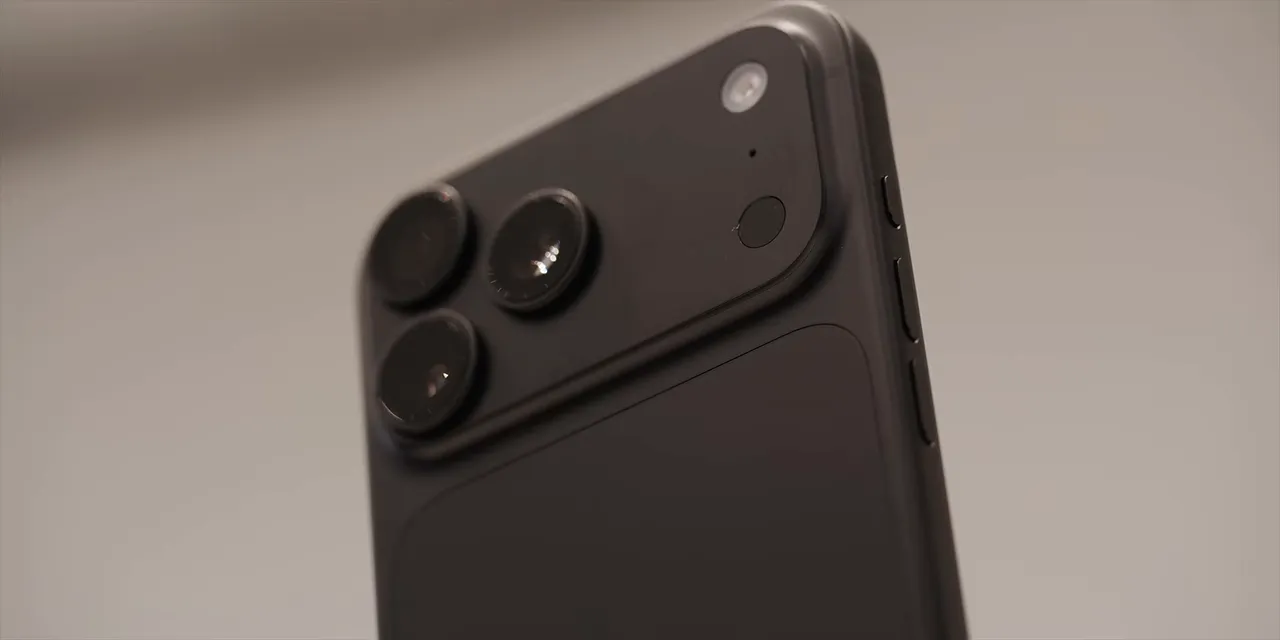
- Burgundy: Clearly positioned as the standout color.
- Glacier: A light blue.
- Silver: A little boring, but more uniform between the glass and metal than before.
- Matte black: Finally. A fully matte black Pro, and definitely the one calling my name.
Prices are up again
The iPhone 18 Pro starts at $1,199, and the Pro Max starts at $1,299. That’s another $100 increase over last year.
Apple has also quietly added $100 to some older phones it still sells, including the iPhone 16 and 17e. So the price increases aren’t limited to the new hardware.
But the Pro Max isn’t the top of the lineup anymore.
iPhone Duo: An iPhone Closed, an iPad Mini Open
The iPhone Duo is Apple’s first folding iPhone, and the first genuinely new iPhone form factor since the original launched in 2007.
We knew roughly what to expect from the rumors. Still, there’s a difference between seeing the shape and actually holding it, opening it, feeling the hinge, and finding out what the crease looks like in person.
The basic idea is simple: an iPhone when it’s closed, something like an iPad mini when it’s open. An iPad mini doesn’t fit in your pocket. This folds in half.
- Cover display: 5.4 inches, high refresh rate, with a corner hole-punch camera.
- Inner display: 7.6 inches, also high refresh rate, bright, with uniform bezels.
- Frame: Titanium, with rounded rails that give you something to grip when opening it.
- Authentication: Touch ID in the right-side power button, not Face ID.
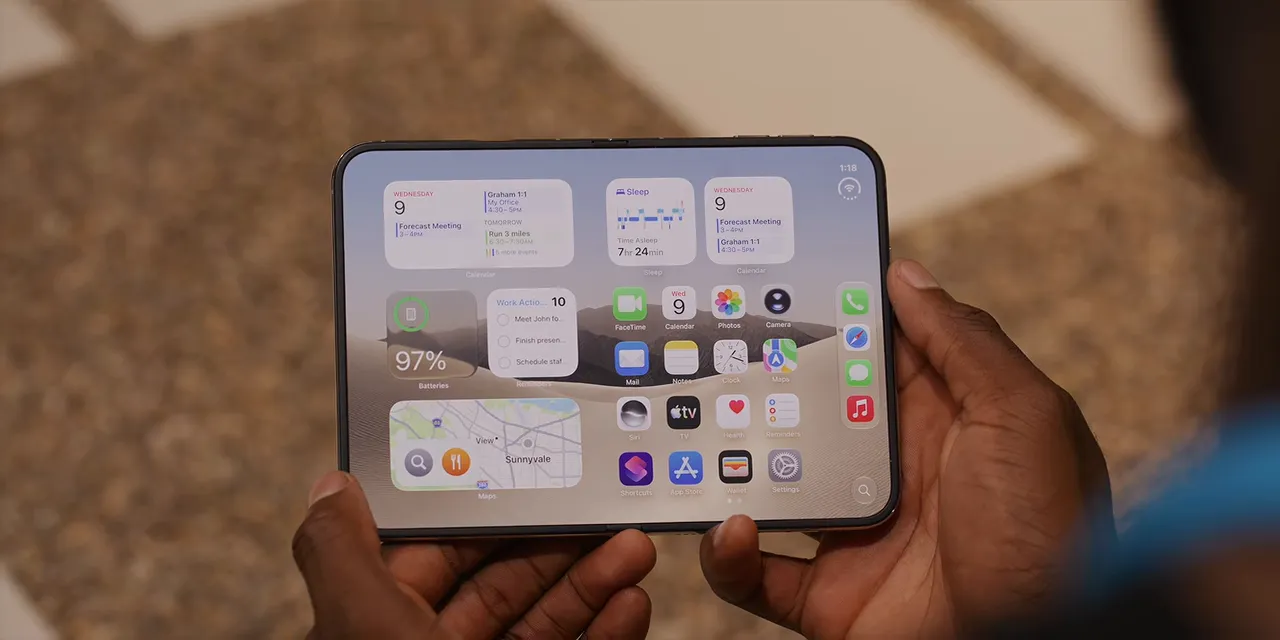
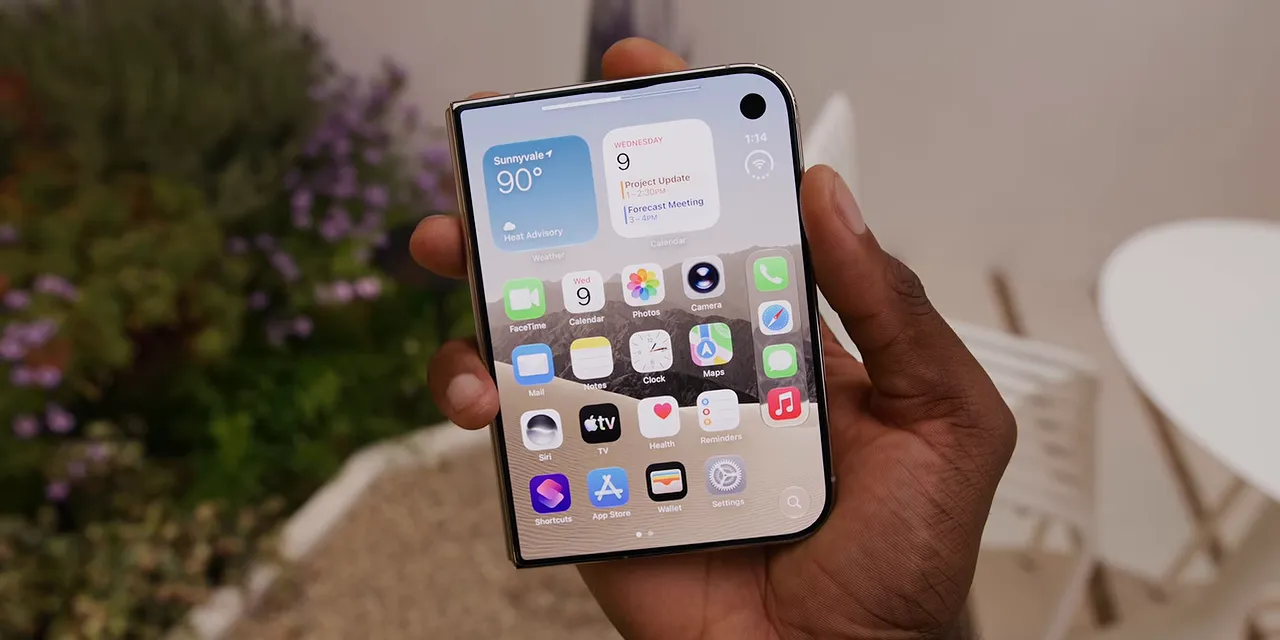
Closed, it’s a squat little iPhone, with the extra thickness you expect from a foldable. The smaller display is already pretty reachable for me, but Apple has gone further by moving a lot of interface elements toward the right side. The dock is vertical on the right rather than along the bottom.
Open it, and there’s this progressive fade between the outer and inner screens. It’s not just an app suddenly appearing on another panel. The transition feels deliberately connected.
The home screens are linked, too. Change the layout outside and that carries over inside. Add a page on one and it appears on the other. You can think of the inner home screen as two cover-screen-sized spaces next to each other.
The Inner Display Is the Hardware Highlight
The Duo’s big screen is uninterrupted from corner to corner because its selfie camera sits underneath the display, around the middle of the right-hand half. Most of the time, with content on-screen, you don’t notice it.
More impressive is the nano-texture-style matte finish across the top layer.
In bright environments, it cuts reflections extremely effectively. I could change the angle of the phone without overhead lights becoming a constant distraction. That’s useful on its own, but it also helps hide the crease.
The crease is not gone. But this is right around the Oppo Find N6 level, which is about the least visible crease I’ve encountered on a folding phone.
It’s a combination of the hinge design, carbon-fiber support plates, relatively stiff ultra-thin glass, and that anti-glare finish. You mostly notice the fold when you deliberately look for it or run a finger over it.
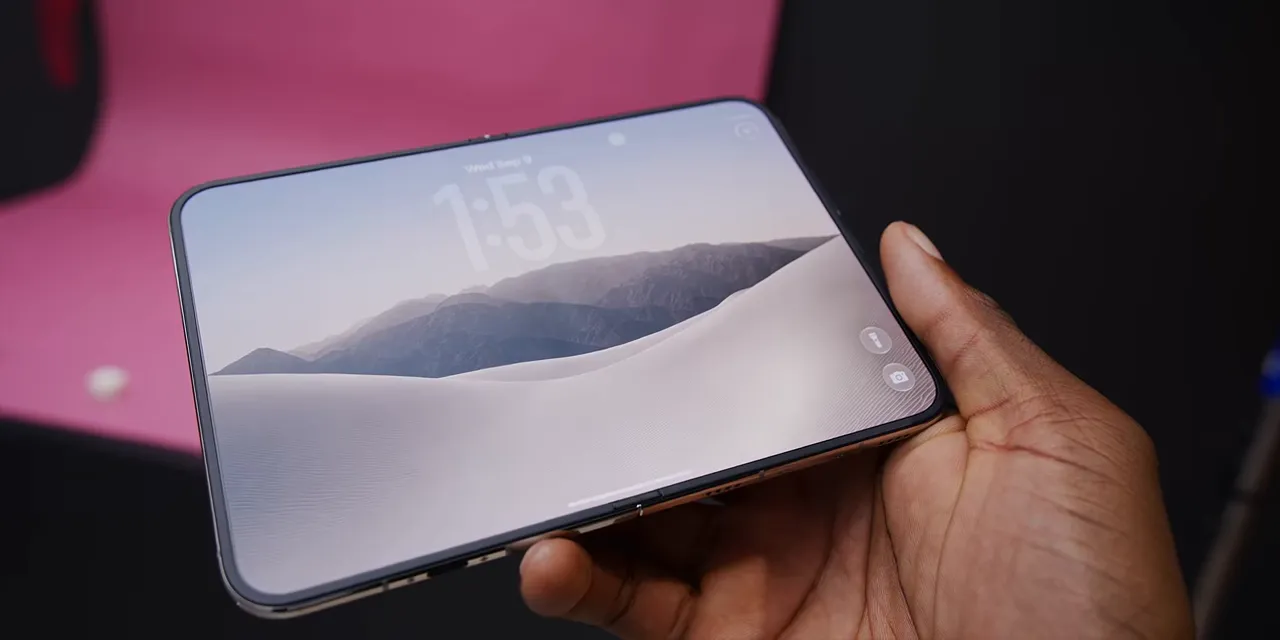
The surface also feels smooth. Your finger glides across it in a way that reminds me of the Find N6. That’s the sort of detail that doesn’t jump out of a spec sheet but matters every time you touch the phone.
The rest of the hardware
The Duo has the A20 Pro chip, MagSafe, and Apple’s new C2 cellular modem, which adds faster connectivity and 5G millimeter-wave support.
On the back are two cameras: a new 48-megapixel primary and the same ultrawide camera as the iPhone 18 Pro. My initial assumption is that the main camera’s sensor is smaller than the flagship Pro’s, but that isn’t something I’ve verified through testing.
There’s no dedicated zoom camera. More on the trade-offs in a minute.
The Software Feels Like iOS With a Little Extra Sauce
At first, I was trying to figure out whether this was iOS, iPadOS, or something in between. The best description I’ve landed on is iOS plus a little extra.
The right-side dock and reachability changes are specific to this device. The transition between displays is standard foldable functionality in principle, but the execution is exceptionally smooth.
When you move back to the cover screen, it quickly continues with whatever was on the right-hand side of the inner display. Apps on the big screen generally behave like iPad apps, using multiple columns instead of simply stretching a phone layout.
You can also run two apps side by side. The gestures I tried were pretty intuitive, and things generally moved where I expected them to.
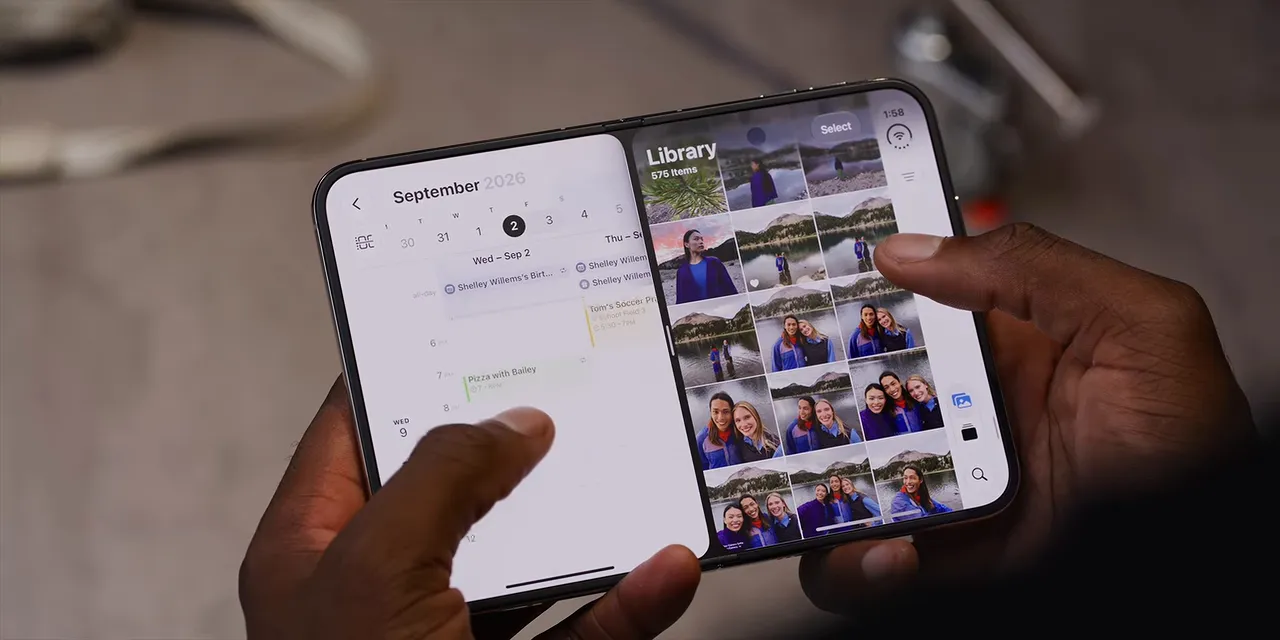
The deeper question is how that works across a normal day, with a much wider selection of apps. A short hands-on can show whether the basics make sense. It can’t settle every question about multitasking.
iPhone Duo vs. Galaxy Z Fold 8: Similar Function, Different Feel
The obvious comparison is Samsung’s Galaxy Z Fold 8. It’s been out for a few months, people love it, and I love it. It’s also essentially the same product idea: a small, passport-shaped foldable with flagship processing power and a very thin body.
Functionally, these phones have a lot in common:
- A main camera and an ultrawide on the back.
- A flagship chip available to their respective platforms.
- Thin designs, with battery life being an important part of the package.
- A fingerprint reader built into the power button.
I’m not calling the Duo’s battery life tested after a couple of hours. But as products, they’re clearly aimed at the same job.
What surprised me was how much more playful and polished the iPhone felt. Forget the horsepower and megapixel numbers for a second. The fit, finish, animations, and physical feel make a real difference.
In that specific sense, the Duo kind of mogs the Samsung.
Fast transitions and thoughtful animations
On other folding phones, I’m used to at least a tiny pause after closing them before the cover display lights up. The Duo had no perceptible delay in my hands-on. It was exceptionally quick every time.
There are smaller touches, too. While the inner selfie camera is active, the pixels covering it go dark so it can see through the display. Close the camera app, and those pixels transition back into the wallpaper. It’s extremely clean.
The quick settings also unfold out of the upper-right corner as you swipe down. Necessary? No. Nice? Very.
Buttons, speakers, and promised Pencil support
The volume buttons are on the top rather than beside the power button. That initially felt a little strange, but the volume behavior follows the button direction: right increases it, left decreases it.
The speaker placement is smart for a foldable. One is toward the front at the top, and the other toward the back at the bottom. Open the phone and you still have one speaker on each half, giving you proper left-right stereo separation.
Apple also says support for the USB-C Apple Pencil is coming later this year, on both the inner and outer displays. That’s a future feature, not something I could assess during this hands-on.
A hinge that makes half-open positions useful
Some foldables have enough spring tension that holding them halfway open is awkward. The Fold 8 doesn’t do this particularly well. The Duo is more comfortable staying partially open, and a number of apps respond to that position.
You can also lock it in tent mode to enter StandBy, showing a clock or alarm. There’s even a gentle glow as it wakes you up.
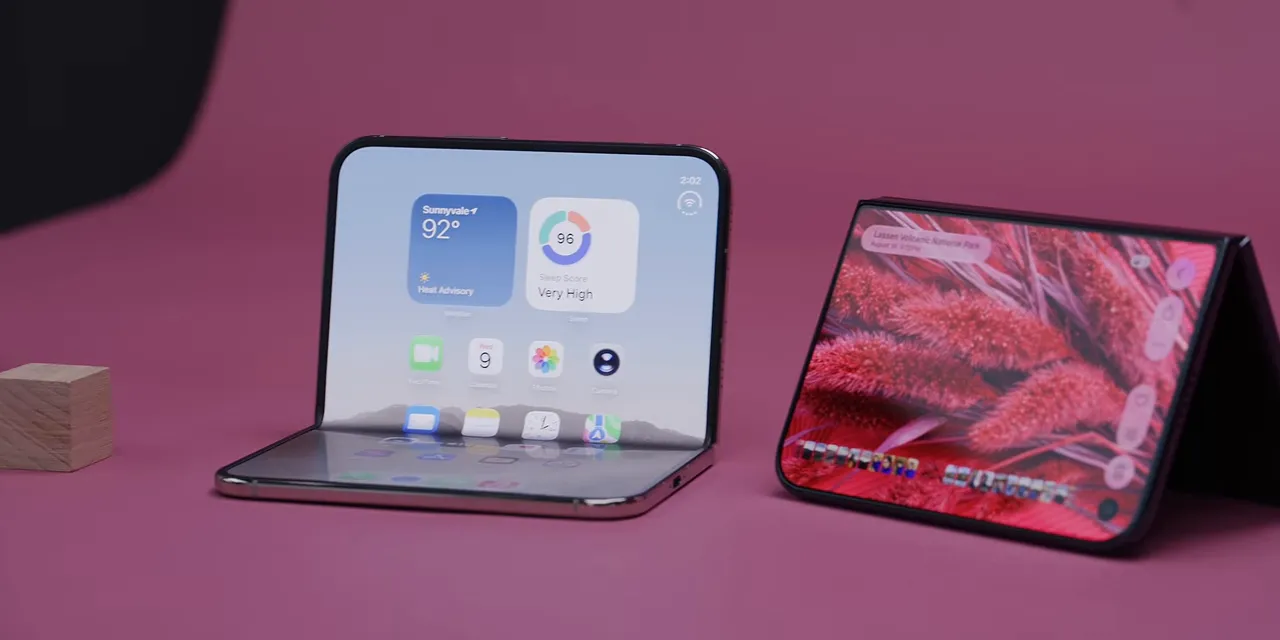
Then there’s the unexpected IP68 water and dust resistance rating. That’s promising for a foldable. The Pixel 10 Pro Fold is the other model that comes to mind with that rating. It isn’t a substitute for long-term durability testing, but it’s a good starting point.
None of these details alone transforms the category. Together, though, they make this phone feel considered.
The iPhone Duo’s Downsides Are Real
All that polish doesn’t make the Duo perfect. A few compromises were immediately obvious.
The asymmetrical cover display
The cover screen has rounded corners on the right and much squarer corners on the left. Functionally, that doesn’t change much. Visually, some people are never going to get over it.
Maybe that’s why it’s called Duo. The screen looks like a D. I don’t know.
A strongly right-handed interface
The more practical issue is how heavily this phone favors the right hand. That’s already somewhat true of a lot of book-style foldables, but moving the dock and other controls to the right doubles down on it.
I couldn’t find a setting to move those elements to the left. That’s worth paying attention to if you’re left-handed.
The dock also holds only four items. I tried adding a fifth, and it wouldn’t let me. Removing an item worked; expanding the dock didn’t.
The hidden selfie camera has a quality cost
An uninterrupted inner display looks great. The video from the under-display selfie camera does not.
I recorded a sample in decent lighting, and the quality was pretty bad. This is a trade-off we’ve encountered before. Samsung used under-display cameras on earlier Folds and eventually moved away from them.
A small hole-punch cutout is usually a perfectly acceptable compromise for a better camera. Hiding the hardware is cool, but if you’re using that big screen for video calls, image quality matters.
Some familiar foldable compromises remain
The Duo also lacks silicon-carbon batteries, ultrafast charging, and a dedicated zoom camera.
So this isn’t Apple arriving with every possible hardware advantage. It’s a specific collection of strengths and trade-offs, wrapped in unusually polished software.
Price, Release Timing, and Who This Is For
The iPhone Duo starts at $2,000 and is coming in October. At the time of these first impressions, preorders are still a couple of weeks away.
Two thousand dollars is obviously expensive. But it’s also a little less than I expected. The Galaxy Z Fold 8 starts at $1,800, so Apple’s asking $200 more.
Between the usual Apple premium, memory pricing pressure, and the cost of a new form factor, I could have imagined a higher starting price. That doesn’t make this cheap. It just makes it less shocking than it might have been.
The clearest audience is someone who has wanted a foldable but stayed on the iPhone side of the fence. Now there’s an option that doesn’t require changing platforms.
And foldables aren’t some nonexistent market. China bought more of them last year than the rest of the world combined. Even if they still feel uncommon where you live, there are plenty of people buying them, and Apple wants to compete for those customers.
My early take: the Duo isn’t perfect, but it has a lot going for it. The display finish, fast screen handoffs, flexible hinge, and little interface details make it genuinely enjoyable. Battery life, rear-camera quality, app behavior, and long-term durability still need a proper review.
Also, Apple having products named Neo and Duo in 2026 is objectively pretty funny. If you know, you know.
The Other Announcements
Alongside the phones, Apple introduced AirPods 5 for $129, with better noise cancellation and a few more features coming down from the Pros.
There’s also the Apple Watch Series 12, including some always-listening features that sound a little freaky at first pass. Those deserve a closer look rather than a rushed conclusion.
For now, the Pro iPhones are about finding out whether the internal upgrades deliver. The Duo is about something more immediately tangible: a new kind of iPhone that’s already making a strong first impression.
Sponsored: Ridge Accessories
Ridge sponsored this coverage, and its current lineup includes accessories designed to match the new iPhone colors.
- Power Bank: Five-in-one power delivery for charging multiple items, plus MagSafe compatibility. The Duo supports both wired charging and MagSafe, so either approach works.
- Tracker Card: A credit-card-sized tracker for a wallet or bag, with a loud ring for locating it nearby. It now supports both iPhone and Android and comes in Basecamp Orange.
- Ridge Wallet: The revised MagSafe version sits flush against the phone with a stronger, more secure attachment. There are color-matched options and transparent finishes, including Phantom, which is my personal favorite.
|


