One year, a phone is four times more shatter resistant than its predecessor. The next year, it is three times more scratch resistant. Then another generation arrives with another huge improvement in drop resistance.
Stack those headlines together, and it sounds like smartphone glass should be approaching superhero territory. Yet screens still scratch. Phones still shatter. And a little sand in your pocket can still ruin your day.
Those marketing claims are not necessarily lies. But they leave out a pretty important distinction: scratch resistance and shatter resistance are different properties, and optimizing for one can work against the other.
Key Takeaways
- Scratch resistance and shatter resistance are different properties that can involve competing material priorities.
- Successive durability headlines can emphasize different improvements rather than one continuously multiplying gain.
- Drop performance depends on the whole phone's design, not just its cover glass.
- Modern phone glass remains vulnerable to scratches from harder particles such as quartz.
Scratch Resistance Is Not Shatter Resistance
The simplest way to think about this is as a pair of connected sliders.
Make a material harder, and it generally becomes more difficult to scratch. But that can also make it more brittle and more susceptible to shattering. Move toward a softer, less brittle material, and it may survive an impact better while becoming easier to scratch.
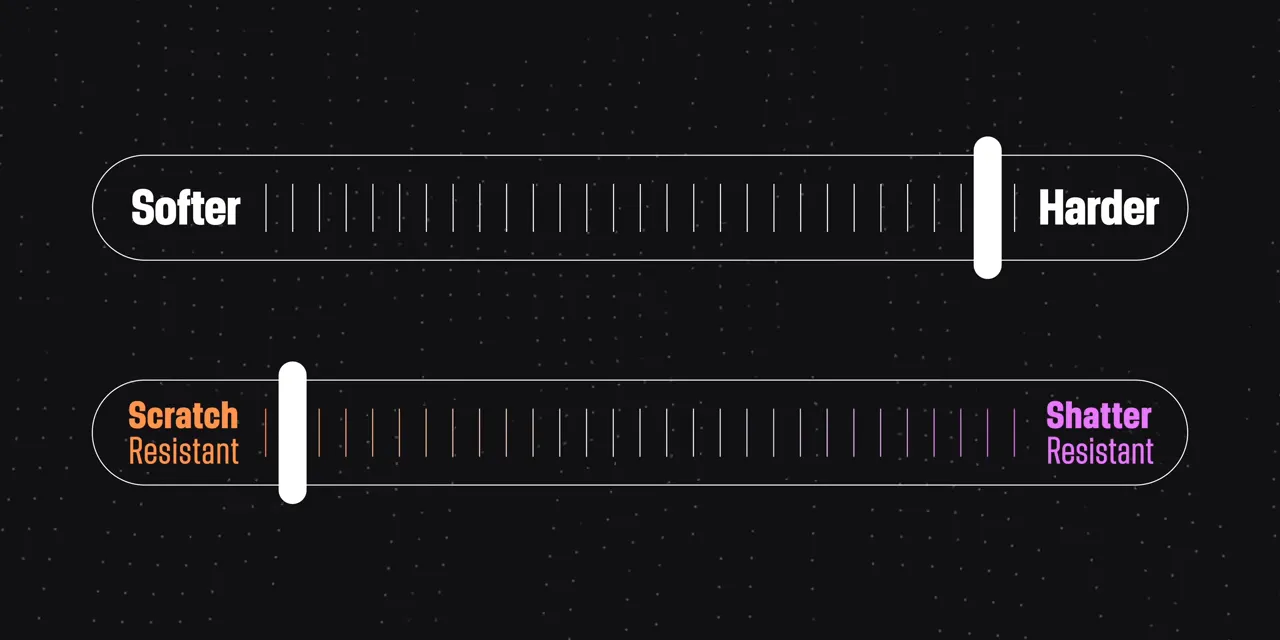
That is a simplified explanation, not a complete account of glass chemistry. Manufacturers do plenty of work on composition and other factors. But it explains why a dramatic improvement in one kind of durability does not automatically mean a dramatic improvement in the other.
So when a phone company announces that its new glass is three or four times more shatter resistant, there are two things worth asking:
- What does that multiplier actually measure? Without the test conditions and comparison, the number alone does not tell you how your phone will handle a real fall.
- What happened to scratch resistance? A headline about surviving drops does not answer whether the surface is harder to scratch.
The same questions apply in reverse. Better scratch resistance is great. It is not a promise that the phone will bounce off concrete.
How Gorilla Glass Headlines Build an Impression of Constant Progress
Many high-end smartphone makers do not manufacture their own cover glass. They use products such as Corning Gorilla Glass, whose history in smartphones goes back to the original iPhone in 2007.
I went back through Gorilla Glass product claims, website material, and information sheets. A pattern emerged: the big headlines repeatedly shift between scratch resistance and drop resistance.
Gorilla Glass 3 emphasized a fourfold improvement in scratch resistance. Later generations emphasized better drop performance. Gorilla Glass Victus brought scratch resistance back into the headline, while subsequent products again highlighted drops.
It is clever. Every new announcement can sound like another enormous step forward in the same category, even though the category being emphasized keeps changing.
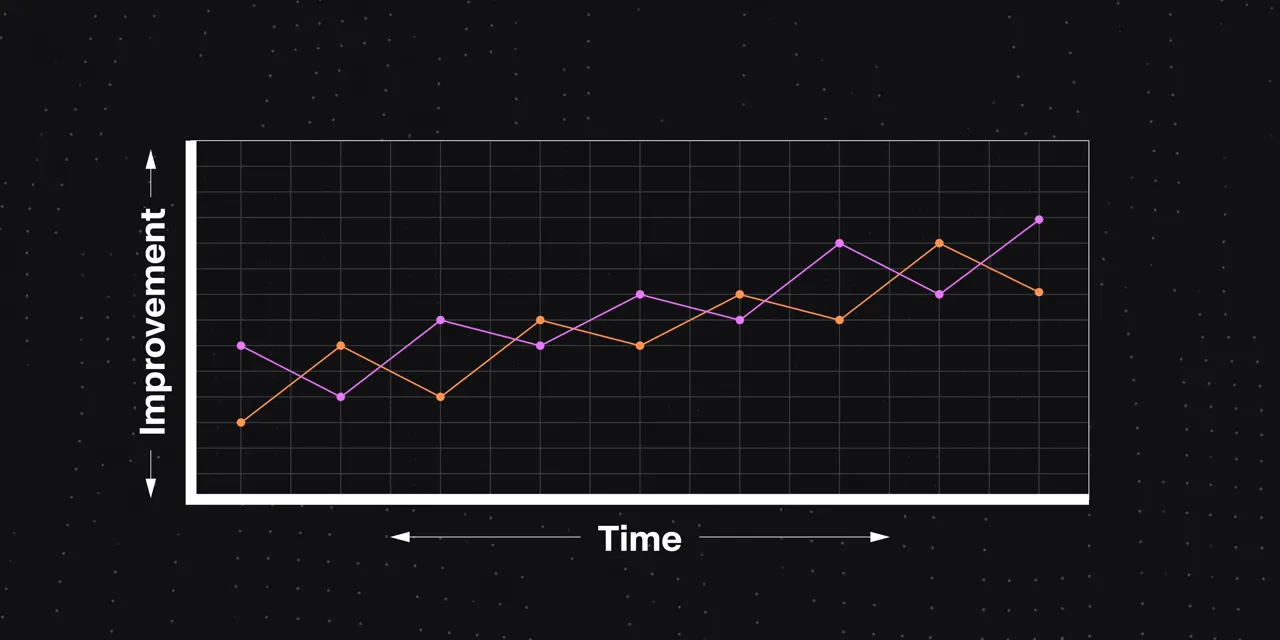
The mental picture created by the headlines is one steep curve shooting upward. A more useful picture has two separate curves: one for scratch resistance and another for shatter resistance, with different generations prioritizing different gains.
That does not mean nothing improves. Chemistry matters. Engineering matters. It means that multiplying every impressive number together does not give you a meaningful measure of how durable today's screen is.
Why Modern Phone Glass Still Scratches
Despite all those generations of improvements, familiar scratch tests still produce familiar results: marks around level six, with deeper grooves around level seven.
Those levels refer to hardness testing. The important everyday detail is that quartz, a common component of sand and grit, is hard enough to scratch phone glass.
That means the tiny particles sitting in a pocket can be a problem. A screen does not need to suffer some spectacular accident to pick up damage. Contact with harder grit can be enough.
More scratch resistant does not mean scratchproof. A new product name or a large multiplier does not make the underlying material immune to harder particles.
This is the disconnect that makes the marketing feel so strange. The announcements sound revolutionary, but the thing in your hand is still subject to some very familiar limitations.
Ceramic Shield Does Not Get a Free Pass
And no, this is not just a Gorilla Glass thing.
Apple introduced Ceramic Shield with the iPhone 12, promoting four times better drop performance. Ceramic Shield 2, introduced with the iPhone 17, emphasized three times better scratch resistance.
Different generations. Different headline properties. Same distinction.
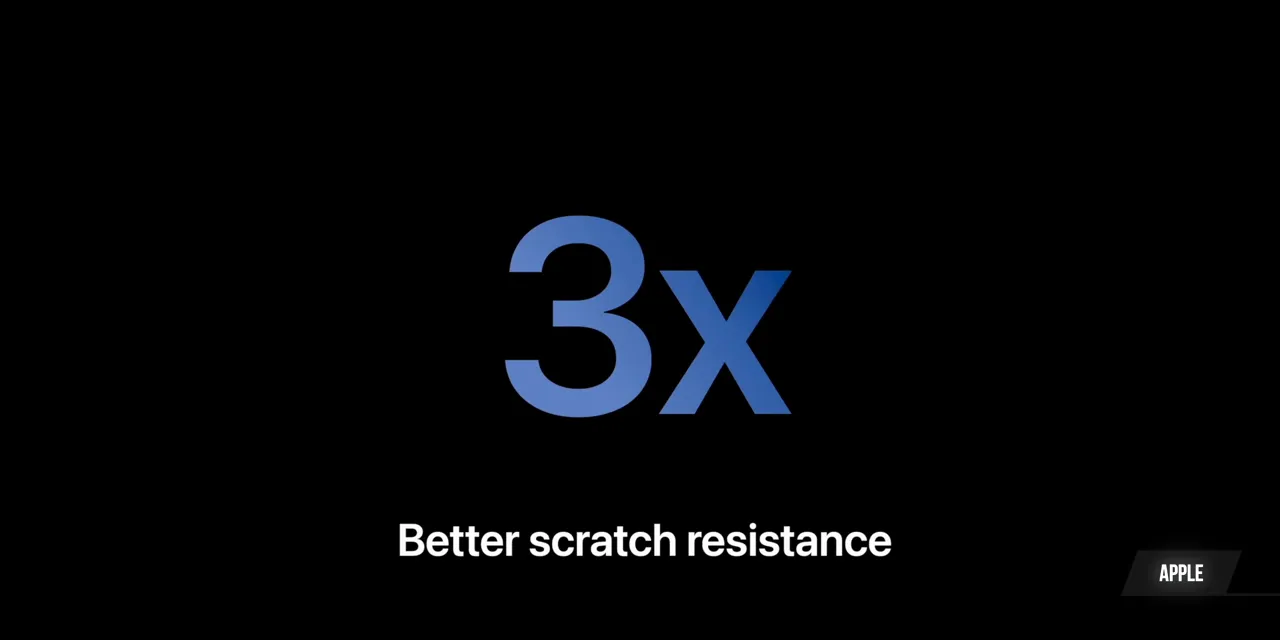
Ceramic Shield is good. That is not the argument. The argument is that better performance in one test should not turn into an assumption of invincibility across every kind of damage.
A drop test tests the whole phone
There is another wrinkle here. Independent iPhone 12 drop tests have often supported the broader claim that the phone survives falls better. People have tried to make those tests as controlled as possible, and the improvement can be real.
But crediting all of that improvement to the glass would be a stretch.
Whether a screen shatters also depends on factors such as:
- The shape of the display.
- The thickness and material of the surrounding bezels.
- Whether the edges are flat or curved.
- The way the phone's overall design protects the glass during impact.
The iPhone 12 famously returned to flat, squared-off sides after the more rounded iPhone 11. That design change matters when discussing how the phone handles a drop.
A result for the complete device bundles together the glass, the frame, and the rest of the physical design. It cannot, by itself, isolate how much improvement came from the cover material.
Better drop performance is a whole-phone result, not automatically proof of an equally large improvement in the glass alone.
The Glass Improvements That Do Not Get the Big Headline
Some of the most interesting things about a phone's glass are not about whether it survives a dramatic fall.
There is the oleophobic coating, which helps repel fingerprint oils and makes the surface feel smoother as a finger slides across it. There are also anti-reflective treatments, which reduce reflections.
These are meaningful parts of using a screen every day. They just do not fit quite as neatly into a giant “three times better” durability announcement.
The takeaway is not that smartphone glass never gets better. It is that “better” needs a label. Better against scratches? Better in a particular drop test? Better at resisting fingerprints or reflections?
The next time a keynote promises a huge leap in phone glass, keep those questions separate. A scratch-resistance claim is not a drop-resistance claim, and neither is a guarantee.
Glass is still glass.


