The Tesla Cybertruck somehow feels less real when you’re standing next to it. It’s a giant stainless steel triangle that spent four years looking like a concept car, and now there’s an actual truck underneath all those angles.
I spent a day with a near-final, triple-motor Cybertruck just as customer deliveries were beginning. This was still a test vehicle, with a few prototype details, so consider this a deep first drive rather than a long-term review. The prices, specifications, and planned options here reflect what Tesla shared at that launch-stage test.
There’s a lot that’s genuinely impressive: ridiculous acceleration, useful onboard power, a spacious cabin, and steering that makes a big pickup feel surprisingly small. There are also some very Tesla decisions that require retraining your muscle memory. And no, the wildest thing about driving it isn’t the shape.
Quick Summary
- The triple-motor Cybertruck combines extraordinary acceleration with launch pricing around $100,000.
- Steer-by-wire and rear-wheel steering make the large truck feel surprisingly nimble.
- Closing the tonneau cover blocks rear-window visibility, requiring reliance on the central camera display.
- This first drive left towing, off-road capability, winter usability, and long-term quality untested.
Table of Contents
- Cybertruck Specs: Fast, Capable, and More Expensive Than Expected
- The Stainless Steel Body Is More Than a Styling Choice
- The Truck Bed Has Real Utility, With One Big Visibility Trade-Off
- No Door Handles, Plenty of Fingerprints
- The Front Camera Helps, but the Frunk Is Small
- Inside: Huge Glass, Straight Lines, and Lots of Storage
- The Back Seat Has a Useful Cargo Trick
- Cybertruck Controls and Software: Familiar Tesla, Better Buttons
- The Steering Is the Craziest Part
- Driving the Cybertruck: Quiet, Responsive, and Absurdly Quick
- The Giant Windshield Wiper Actually Works
- 800-Volt Architecture, Charging, and the Planned Range Extender
- First-Drive Verdict: Impressive, With Plenty Left to Prove
- Sponsor: Ridge Carry-Ons
Cybertruck Specs: Fast, Capable, and More Expensive Than Expected
Tesla outlined three configurations: a triple-motor version, a dual-motor version, and a single-motor rear-wheel-drive truck planned for later.
The truck I drove was the triple-motor model, called the Beast. It has one motor up front and two in the rear, with rear torque vectoring. It isn’t simply the Model S Plaid powertrain dropped into a pickup, but the numbers are similarly absurd.
- Triple-motor performance: Approximately 845 horsepower, a claimed 2.7-second zero-to-60 time, and an approximately 11-second quarter mile.
- Triple-motor price: About $100,000 at launch.
- Dual-motor version: More than 600 horsepower, with the pricing expectation during this test around $75,000 to $85,000.
- Maximum range: Approximately 340 miles for the most efficient configuration, not necessarily the particular truck and tire combination I drove.
- Maximum towing: Tesla quoted 11,000 pounds.
- Payload: Tesla quoted up to 2,500 pounds.
That price is important. The Cybertruck originally came with expectations of a much lower starting price. At around $100,000 for this version, it doesn’t have the price advantage some people thought it would.
It’s also smaller than the original show truck. Tesla described it as roughly 5% smaller in each dimension, and my bumper-to-bumper measurement came out around 224 inches. We had an F-150 Lightning alongside it, and the Cybertruck is in that same general size class, just a little smaller.
The Stainless Steel Body Is More Than a Styling Choice
You can’t really separate the Cybertruck from its exterior. Huge stainless steel panels, almost no curves, sharp corners, and reflections that change dramatically with the light. It looks surreal in an ordinary parking lot.
Some of those corners are genuinely pointy. You probably aren’t going to walk up and poke the front of somebody’s truck, but these are still exposed corners of stainless steel. That stood out immediately.
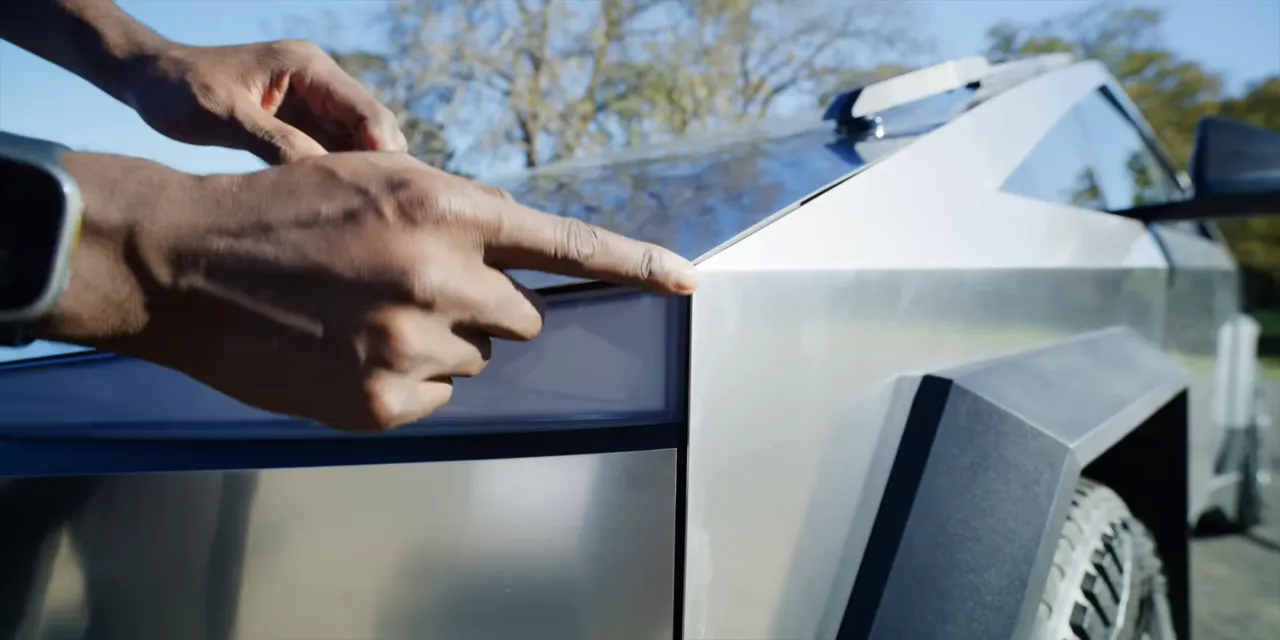
The manufacturing side is interesting, too. Tesla’s engineers described the challenge of stamping stainless steel: you press it into shape, but it springs back. The tooling has to account for that spring-back so the panel settles into the intended shape.
I saw several Cybertrucks during the visit, and their panel gaps and overall fit varied. This particular truck looked pretty good, with generally small, even gaps. But the large front panel still had a little waviness along its edge.
A good-looking test truck doesn’t establish consistency across production. Fit and finish is still something I’d want to assess across customer vehicles.
Mirrors and removable aero covers
Unlike the original concept, the near-final truck has side mirrors. Tesla made them removable, although the factory needs to ship the truck with them for legal reasons. That isn’t a blanket statement that removing them is legal wherever you live.
There are also interior blind-spot indicator lights and side cameras that display a feed when you activate a turn signal.
The initial dual- and triple-motor trucks were set to arrive with bespoke Goodyear tires on 20-inch wheels. Their angular aero covers have two pieces: a plastic center section and an outer rubber section that lines up with the shapes on the tire.
Tesla says the covers add a couple of percent to range. You can remove them if you prefer the exposed wheel, want better brake cooling, or need easier access while airing down for off-roading. Reinstalling them requires lining up both pieces. It also left my hands covered in grime, so it’s not something I’d do casually every afternoon.
The Truck Bed Has Real Utility, With One Big Visibility Trade-Off
The rear profile almost looks like a dump truck, with those tall, sloping sides. Open the tailgate, though, and there’s a fairly practical bed underneath.
The tailgate has a nicely damped opening, but it isn’t powered. You close it manually. The tonneau cover, on the other hand, is motorized and retracts smoothly toward the cabin.
Tesla told me the cover could support a 300-pound standing load. I stood on it, and it held. I did not jump on it, and I wouldn’t treat that demonstration as proof that it can handle every kind of concentrated or moving load.
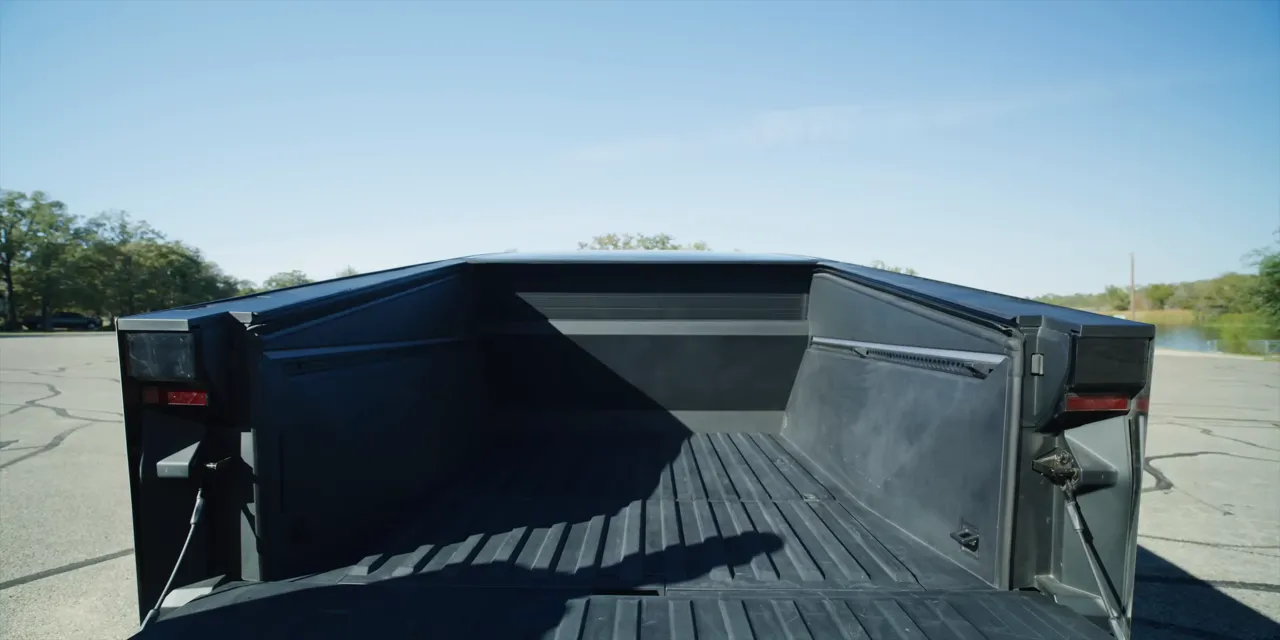
Opening the cover reveals a fixed rear window. Closing it completely blocks the view through that window. That has consequences for the rearview mirror, which I’ll get to shortly.
Bed dimensions and storage
The original Cybertruck had a bare stainless steel bed. Tesla said feedback from construction workers was pretty straightforward: the first thing they’d do was add a protective liner. So Tesla lined it from the factory.
I measured about 72 inches along the bed floor, giving it a nominal six-foot length. There’s an overhang at the front, though. Accounting for that leaves closer to 66 inches of unobstructed length, approximately the published bed length of the F-150 Lightning we had beside it. The distinction matters if you’re loading something tall and rectangular.
There’s also an underfloor storage compartment large enough for a duffel bag and potentially a carry-on. It has a drain plug, so using it as an ice-filled cooler is an option.
Other useful details include bed lighting on both sides, multiple tie-down and mounting points, and a built-in bottle opener. There’s no standard spare tire. Tesla said you could buy one separately and secure it in the bed, but that uses cargo space.
Power outlets and vehicle-to-vehicle charging
The bed includes two 120-volt outlets and one 240-volt outlet. Tesla quoted up to 9.6 kilowatts of output through the 240-volt connection, enough to charge another EV using suitable charging equipment.
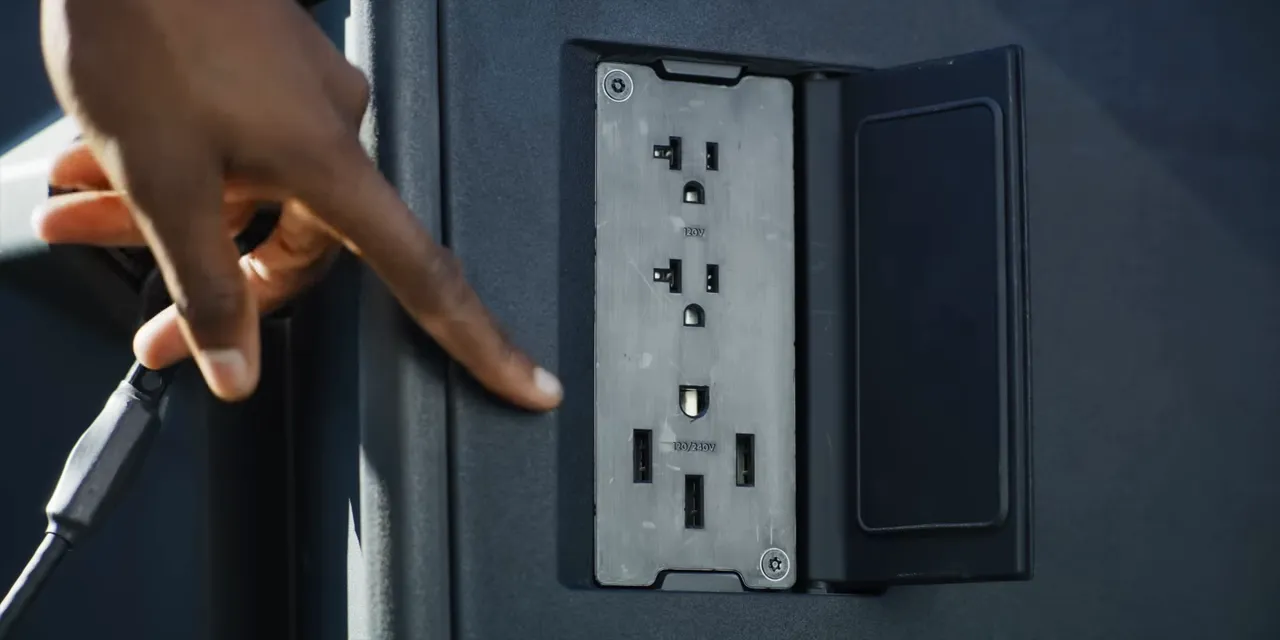
Tesla also described up to 11 kilowatts of export power through the charge port. Supplying a home requires the appropriate compatible equipment and installation, not just plugging the truck into any household outlet.
I’m glad more electric trucks are doing this. A huge battery becomes considerably more useful when it can power tools, other equipment, or another vehicle.
The tonneau controls on this test truck did have a little prototype weirdness. A quick press generally ran the cover automatically, while holding the button appeared to allow partial movement, but stopping it wasn’t completely consistent during my experimenting. That’s the kind of small behavior I’d want to revisit on a delivery vehicle.
No Door Handles, Plenty of Fingerprints
Concept cars love deleting door handles. Usually the handles come back before production. Not here.
To open the Cybertruck, you press a small recessed button on the pillar. When the truck is unlocked, the door pushes outward about two inches. Then you grab the exposed edge and pull it open.
It works. The frameless windows move automatically as needed, the doors close with a substantial thunk, and the rear doors open a full 90 degrees. That wide opening is genuinely useful for getting people or cargo into the back.
My concern is winter. Tesla told me that, if you can break through the ice covering the button and press it, the door mechanism has enough force to push through up to an inch of ice. I didn’t test that, and I’d want a proper cold-weather test before taking it for granted.
The less theoretical problem is fingerprints. People naturally grab the stainless steel below the window, and the marks show up immediately. Without an obvious handle, you also have to explain the entry procedure to someone using the truck for the first time.
Expect a lot of Cybertrucks with very visible handprints around the doors.
The Front Camera Helps, but the Frunk Is Small
Up front, there’s a substantial plastic bumper, two recovery points, and something Tesla hadn’t previously offered on its vehicles: a front-facing bumper camera.
That camera is particularly useful here because the driver can’t see the truck’s nose directly. The giant light bar is the daytime running light; the actual headlights sit in narrower slots lower down.
The front trunk opens and closes electrically using a button beneath the front edge. It’s convenient, but fairly shallow. This is not an F-150 Lightning-sized frunk.
For a practical capacity test, I used two Ridge carry-on suitcases. Both fitted, but only after rearranging them carefully behind the seal. Two of those specific cases were effectively the limit in that test, rather than proof that every pair of carry-ons will fit.
Another funny detail: I kept looking for a Tesla logo and mostly found Cybertruck branding instead. Even the steering wheel uses a stylized Cybertruck silhouette. The familiar Tesla key card was the obvious exception.
Inside: Huge Glass, Straight Lines, and Lots of Storage
The production-style cabin is more conventional than the original concept, which had a yoke and a marble-looking dashboard shelf. This truck has a complete steering wheel, although “squircle” might be the more accurate description.
The windshield is enormous. Tesla described it as the largest automotive windshield, and from the driver’s seat it creates a dramatic canopy stretching far out in front of you. There’s also a large tinted glass roof extending over the rear passengers.
The sun visors use neat magnetic attachments. Around them, almost everything follows the truck’s angular theme, right down to the square and trapezoidal speaker grilles.
The storage layout is pretty sensible:
- Large door pockets and smaller trays.
- A broad, open storage area below the center console.
- Two wireless phone chargers and two cup holders.
- A deep center armrest compartment with a 120-volt outlet and a 65-watt USB-C port.
- A drawer-style glove box opened through the touchscreen.
I still wish the glove box had its own physical opening button. But the amount of usable space is good.
There are electronic door releases and manual emergency releases, touch-sensitive overhead lights, customizable RGB ambient lighting, and an interior-facing camera. The dashboard material is an improvement over the original concept, although this test vehicle wasn’t flawless in its assembly.
Visibility is good, until you need to locate the nose
The cabin feels open, and general outward visibility is good. But the distance from the driver to the base of the windshield is enormous, and I couldn’t see the nose even when I sat up and tried.
You’re looking toward the end of the windshield and estimating where the front of the truck ends. That gets easier with familiarity, but it makes the front camera more than a novelty.
The rearview mirror doesn’t become a camera display
Here’s the bigger adjustment: with the tonneau cover closed, the ordinary rearview mirror can’t show you what’s behind the truck. There’s no digital camera mode built into that mirror.
Instead, the rear camera feed lives on the central touchscreen. You can reposition it within the interface, including a larger preview on the right.
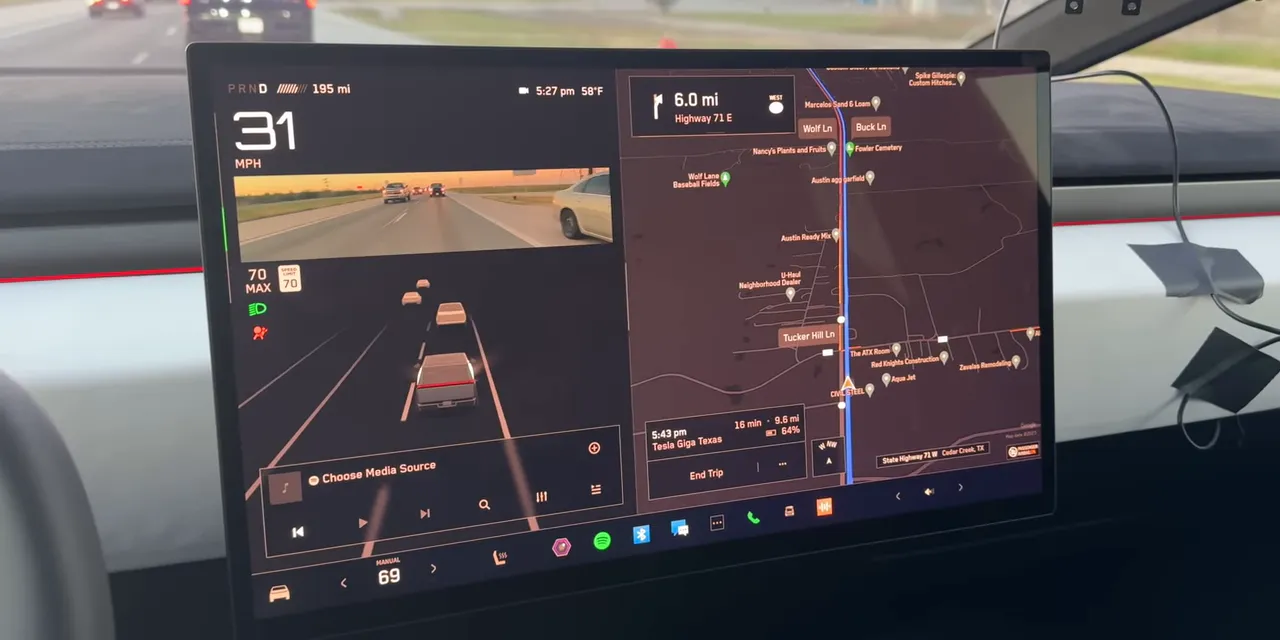
I started adapting to that fairly quickly. But it’s still another muscle-memory remap: glance toward the screen, not toward the mirror.
The overhead controls are unusual, too. Alongside the touch-sensitive hazard control are backup Park, Reverse, Neutral, and Drive selectors. You can select gears through the screen as well, but finding those additional selectors above your head is definitely different.
The Back Seat Has a Useful Cargo Trick
The rear seats have genuinely good legroom in the outer positions. The front seats sit on rectangular risers that leave room to slide your feet underneath. The center position is less generous, but overall this is a spacious back seat.
Then there’s the storage trick: the seat cushions fold upward. The right-hand section lifts independently, while the left two positions lift together, exposing a large floor area for boxes or other cargo you want inside the cabin.
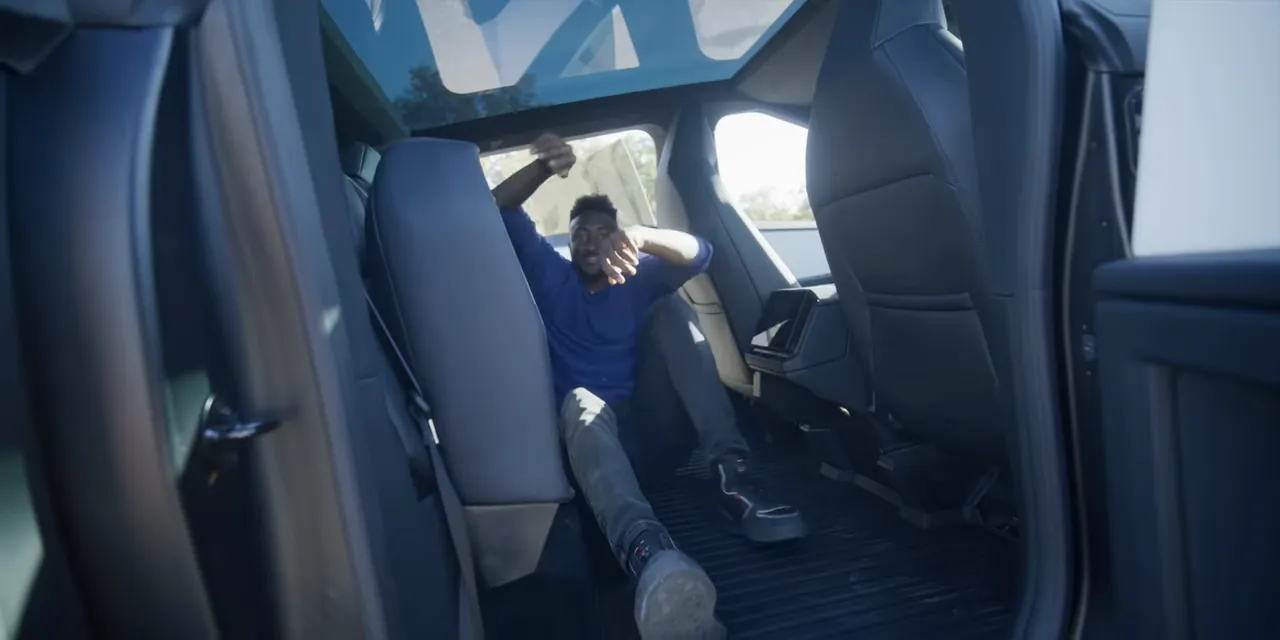
Rear passengers get a 9.5-inch touchscreen for entertainment, airflow controls, and the outer heated seats. Those rear seats aren’t ventilated, despite the appearance of their upholstery, and the middle seat isn’t heated.
The rear screen can also move the front passenger seat to create more space. It doesn’t move the driver’s seat.
Cybertruck Controls and Software: Familiar Tesla, Better Buttons
The central screen measures 18.5 inches, making it Tesla’s largest at the time of this test. The basic layout is familiar, but the graphics and vehicle visualization have a Cybertruck-specific theme.
I think Tesla did a really good job here. Outside Apple CarPlay and Android Auto, this is still some of my favorite car software.
The main vehicle graphic has floating touch targets for things like the tailgate, tonneau cover, and charge-port flap. More interestingly, it reflects the truck’s state in real time: lower a window halfway, and the rendered window moves halfway. Turn the wheel, change the lights, or adjust the suspension, and the visualization follows.
Navigation can occupy the right two-thirds of the display while vehicle information remains on the left. The bottom dock keeps common functions accessible, including heated and ventilated front seats and a heated steering wheel with two levels.
Actual steering-wheel buttons and a normal horn
There are still no traditional stalks. Turn signals, headlights, the wiper, voice controls, media, and driver-assistance controls are handled through the wheel and screen.
But the steering-wheel buttons physically click and move. They aren’t just touch surfaces vibrating to imitate buttons. That’s an improvement.
And the horn is in the center of the wheel, where you expect it. I appreciate that more than I probably should.
Suspension and driving profiles
The Controls menu handles everyday items such as locks, lights, and screen brightness. Dynamics is where you adjust acceleration, ride, handling, and preferred ride height.
On the triple-motor truck, the presets include Comfort, Standard, and Beast. The name is a little much, but Beast is the maximum-acceleration setting.
A custom profile lets you combine aggressive acceleration with softer damping, or choose a firmer, more focused ride. You don’t have to make every setting equally intense.
The height adjustment is quick, with an entry setting that lowers the truck for easier access and additional low, medium, high, and off-road settings. Tesla described roughly a foot of adjustment across the full height range and approximately 17 inches of clearance at the upper end, with Extract as the highest setting. Aluminum skid plates and aero shields protect the underside.
The Steering Is the Craziest Part
Not the stainless steel. Not the acceleration. The steering is the most surprising thing about this truck.
It combines steer-by-wire with active rear-wheel steering. There’s no conventional mechanical steering connection controlling the front wheels, and you don’t need multiple hand-over-hand rotations to make a tight turn.
At low speed, reaching full steering lock takes less than 180 degrees of steering-wheel movement from center. Your instinct to reach over the top and prepare for another rotation becomes unnecessary.
Rear-wheel steering makes it feel smaller
At lower speeds, Tesla described rear-wheel steering of up to 10 degrees opposite the front wheels. That effectively shortens the wheelbase for maneuvering, helping the truck turn more tightly in parking lots and confined spaces.
Above roughly 40 mph, the rear wheels instead move slightly in the same direction as the fronts, about one or two degrees, to make lane changes feel more stable.
The result is a big pickup that feels noticeably more nimble than its dimensions suggest. Compared with the conventional steering of the F-150 Lightning, the difference in tight maneuvers is substantial.
There’s a learning curve. I kept putting my hand into position for a big steering input, then realizing I only needed a small movement. But once I started adjusting, I considered the steering a real advantage.
Driving the Cybertruck: Quiet, Responsive, and Absurdly Quick
The first impression is actually pretty familiar: it feels like a Tesla. Throttle response is immediate, the cabin is spacious, and the electric drivetrain delivers power without hesitation.
Then you accelerate.
A pickup on all-terrain tires should not feel this quick. You don’t need 845 horsepower for ordinary truck tasks, but getting up to highway speed makes the sheer force impossible to ignore.
The suspension has a noticeable range between its softer and firmer settings. The body feels very rigid, leaving the suspension to do the work of controlling comfort and movement. The adjustment isn’t just a barely perceptible menu change.
The laminated windows also do a good job keeping the cabin quiet. At highway speed, more tire noise comes through from the all-terrain tread, even though Tesla said these bespoke tires have internal foam.
I also noticed a little steering feedback, which was unexpected given how isolated some other Teslas feel. More importantly, the truck responds to small steering inputs with surprising immediacy. In that specific sense, it felt more responsive than my Model S Plaid. That’s a strange thing to say about a pickup.
Tesla made durability claims about the glass and stainless steel body, including ballistic resistance. I didn’t test those claims. They shouldn’t be confused with something established by this drive.
The Giant Windshield Wiper Actually Works
The wiper looks ridiculous because it is enormous. But in use, it cleared the driver’s view and a substantial portion of the passenger’s side, even though it didn’t sweep the entire windshield.
That answers the basic question: yes, it works as a wiper. What I can’t answer is how well that huge assembly handles heavy snow or ice buildup. Moving something this large through winter conditions is a different test from running it during a first drive.
800-Volt Architecture, Charging, and the Planned Range Extender
The Cybertruck uses an 800-volt high-voltage architecture, plus a 48-volt low-voltage system instead of the conventional 12-volt setup.
The high-voltage idea is straightforward: delivering power at higher voltage can reduce the current required, allowing lighter wiring and lower losses when the system is designed around it. Tesla also described faster charging potential with appropriately capable V4 Supercharging equipment.
The truck remains compatible with earlier V2 and V3 Superchargers. An 800-volt vehicle doesn’t mean every charging station automatically delivers a faster session. For general context on electric vehicle batteries and charging, the EPA’s electric vehicle technology guide is a useful reference.
Tesla described the familiar Autopilot feature set during the briefing, but driver-assistance performance wasn’t something I evaluated in depth on this drive.
More range, at the expense of bed space and weight
Tesla told me the battery pack discussed for these trucks was approximately 123 kilowatt-hours. It also outlined an optional range-extender battery that would sit in the bed.
The proposed addition was about 120 miles of range, potentially bringing the appropriate configuration into roughly the 400- to 450-mile neighborhood. Those were launch-stage plans and estimates, not something I tested.
The trade-off is obvious: you carry more battery weight and give up some bed space. For someone towing or hauling over longer distances, that could be worthwhile. But the advertised extra range isn’t a guarantee of that same mileage with a trailer attached.
First-Drive Verdict: Impressive, With Plenty Left to Prove
The Cybertruck’s strongest qualities are easy to identify: massive straight-line performance, genuinely useful rear-wheel steering, a tight turning circle for its size, thoughtful software, and access to Tesla’s charging network.
Its compromises are equally clear. The styling is going to be a deal-breaker for some people. The driver can’t directly locate the nose. The closed tonneau cover turns the central screen into your rearview reference. And the launch pricing puts it firmly among expensive electric pickups, rather than below them.
The F-150 Lightning we used for comparison cost significantly less than this triple-motor truck. Rivian’s R1T and the electric Hummer are expensive, too, but the Cybertruck doesn’t get to win simply by being cheaper.
Most importantly, this wasn’t a full truck review. I didn’t tow, test the trailer features, fill the bed with rocks, go off-road, take a long road trip, or live with the truck through bad weather. Those are essential tests before deciding how good it is as a working pickup.
After a day, though, I’m impressed. Underneath the stainless steel refrigerator-on-wheels appearance, there’s a genuinely interesting vehicle. The steering and performance are already compelling. Production consistency, winter usability, and real truck work are the parts that still need to earn their verdict.
Sponsor: Ridge Carry-Ons
The Ridge carry-ons used for the frunk test have a shell Ridge describes as 30% thicker than a standard carry-on, carbon-fiber accents, a grippy handle, and weatherproof construction. Matching wallet colors include Royal Black, Alpine Navy, Basecamp Orange, and Matte Olive. Ridge also promoted a 99-day risk-free trial.
|


