Can you trust me? Ultimately, that is your call. What I can do is explain how I make tech reviews, where the money and products come from, and the boundaries I have set for working with companies.
I laid out my review ethics and policies about six years ago. A lot of those policies have stayed exactly the same. But the channel has evolved, tech reviews have changed, and the creator landscape is much bigger now. There are more people making more kinds of tech content, with different approaches to sponsorships, access, and independence.
So it is worth refreshing the lines in the sand. Not because publishing a set of rules automatically earns trust, but because you should know what those rules are before deciding how much weight to give my opinions.
Key Takeaways
- MKBHD reviews are unpaid, receive no manufacturer previews, and cannot be sponsored by the product’s maker.
- Affiliate links and company-provided devices are disclosed, while the team pays its own travel expenses.
- Sponsored content is clearly disclosed and kept separate from product reviews.
- Early access creates real incentives, so trust depends on consistent independence over time.
The Rules Behind MKBHD Reviews
These are self-imposed policies. They are the boundaries I have chosen for this channel, and the core ones have not changed:
- No paid reviews. I have never accepted payment to make a review, and I never will.
- No manufacturer previews. Companies do not get an early look at a review before publication. They get to see it at the same time as everyone else.
- No reviews sponsored by the product’s manufacturer. A company cannot sponsor my review of its own product.
- No direct investments in companies whose products I review. If I invest in a company even remotely connected to a video, I will prominently disclose that relationship.
I also keep a reviews playlist updated with every product review I have made. Usually, the title includes the word “review,” but the playlist is there to remove ambiguity if the format is ever unclear.
That distinction matters more than it might initially seem. A first impressions piece, a showcase, and a review are not interchangeable. I will get into that, but first there are a few other relationships worth making explicit.
Affiliate Links, Review Devices, and Travel
Affiliate links are labeled
Any affiliate product link associated with a video is clearly identified. Sometimes that is a written label in the description. Sometimes it is YouTube’s tagged product feature, which includes an “earns commission” notice.
The arrangement is pretty straightforward: if you follow that link and decide to buy the product, a small commission helps support the channel. An affiliate link is not the same thing as a sponsorship. It is still a financial relationship, though, which is why the label matters.
Provided products are disclosed and usually returned
If a company provides a device or another piece of tech for a video, rather than us purchasing it, that is noted in the video description.
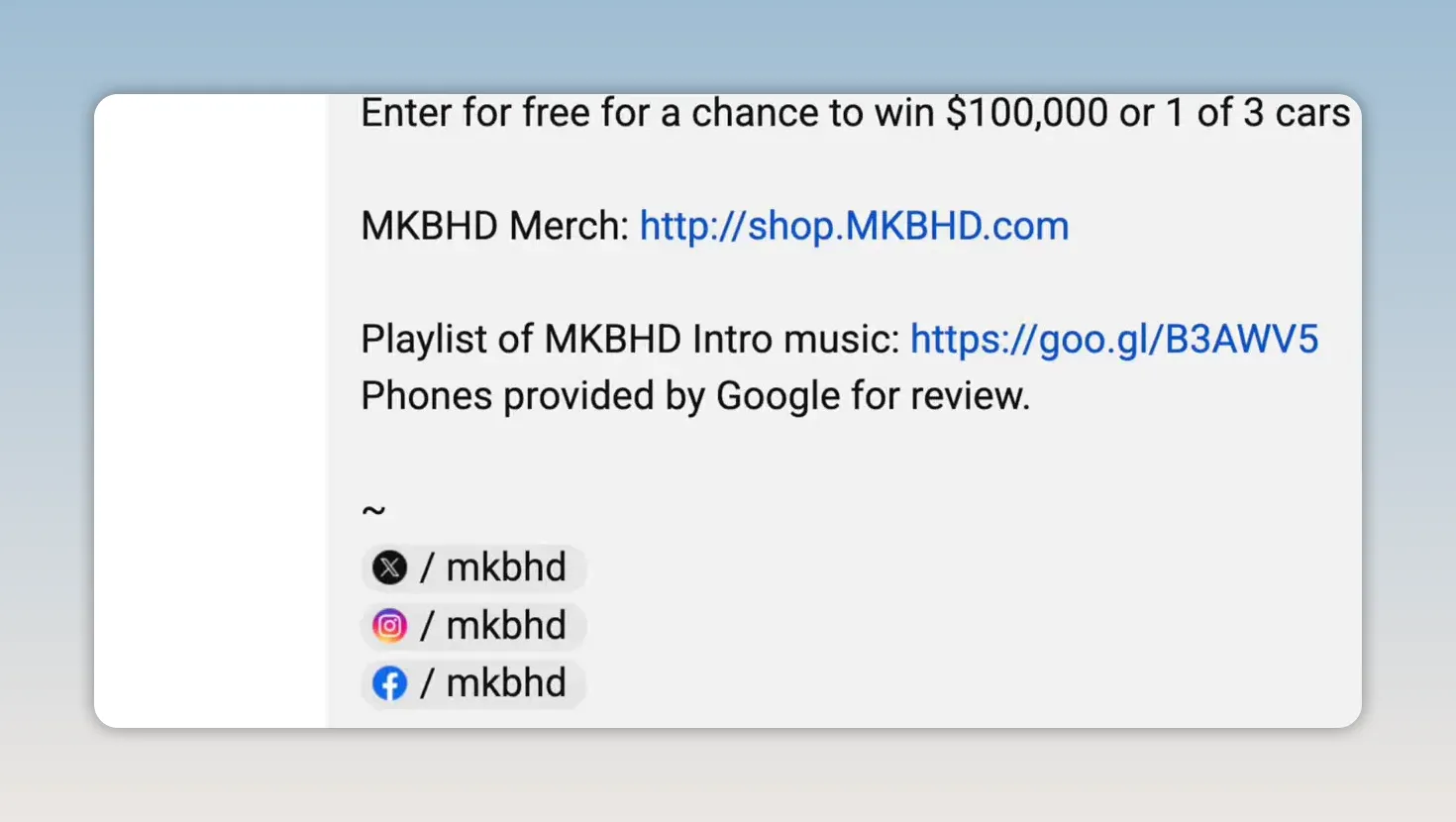
Something a lot of people do not realize is that most of those devices go back to the manufacturers, usually about a year later. I get a mountain of emails asking for tech once I am finished reviewing it, but it generally is not ours to give away.
After the Smartphone Awards at the end of the year, for example, I go through the phones we did not buy, find the return labels or shipping addresses, and send them back.
We pay our own way
For MKBHD videos, we refuse company-paid travel, flights, hotels, and similar arrangements. We pay our own expenses so we can make the videos we want to make.
Does that particular choice make a huge difference to the final piece? Maybe not in a way that is immediately obvious. We keep doing it because it feels right for us.
I have plenty of creator friends who accept flights to tech events. That is how their businesses work, their audiences are comfortable with it, and economically it makes sense for them. I am not presenting my policy as a declaration that everyone else has to operate identically.
The point is transparency: every creator draws these boundaries in a slightly different place. You should know where mine are.
Tech Reviews and Journalism Are Close, but Different
One way I think about tech content is as a spectrum. At one end are formally trained journalists. At the other are people making their very first videos, maybe someone picking up a phone to talk about a pair of headphones they just bought. In between is an enormous range of experience, formats, and expectations.
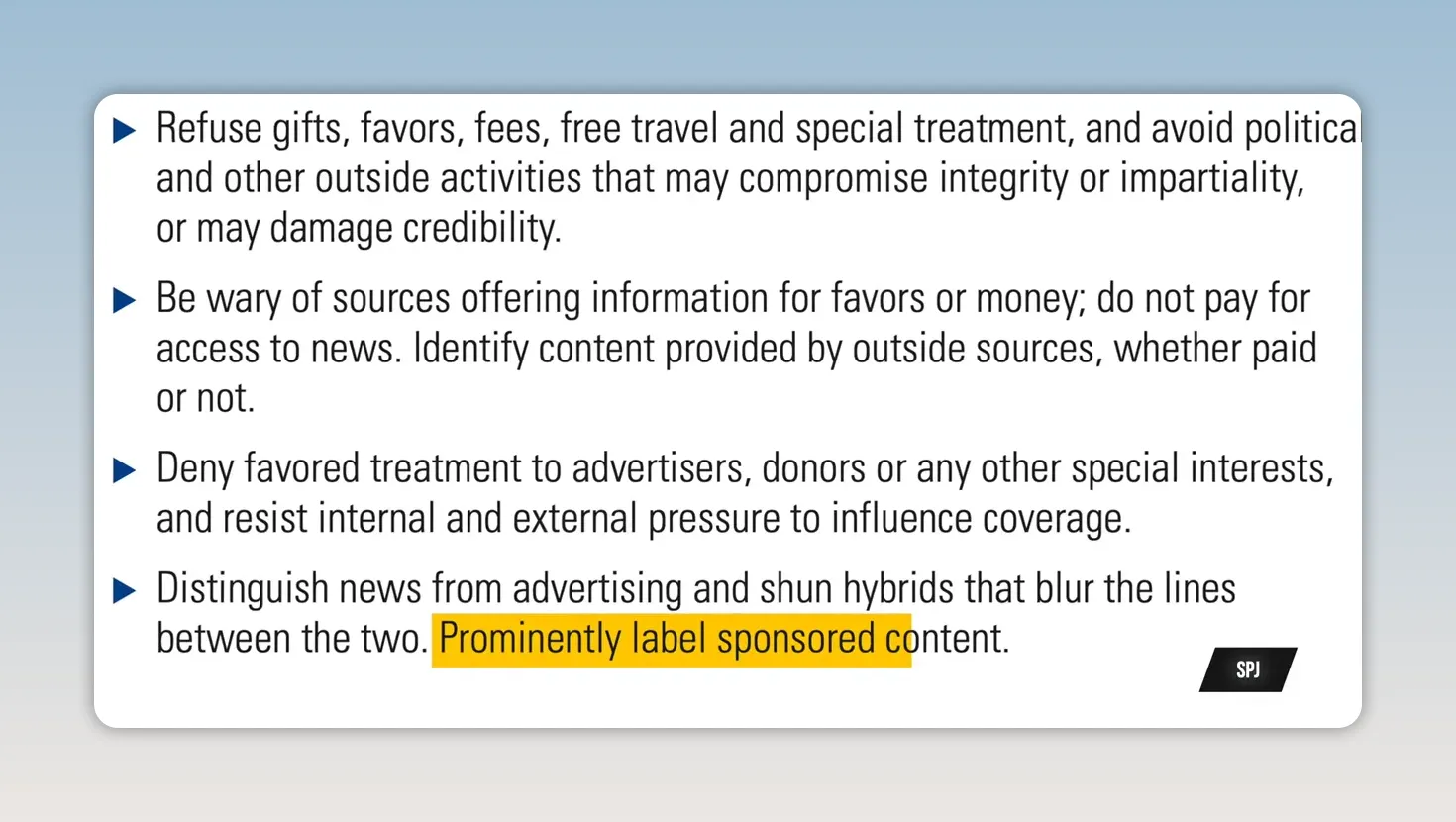
Journalism has established ethical frameworks. The Society of Professional Journalists’ Code of Ethics, for example, sets out principles including minimizing harm, acting independently, and being accountable and transparent. It also calls for clear separation between editorial content and advertising, with sponsored content prominently labeled.
Someone making their first headphone TikTok may not have a formal set of policies at all. That is part of what makes this space so varied.
I place myself closer to the journalism end of that spectrum at this point, but I do not consider tech reviews on YouTube and journalism to be exactly the same thing. They are closely related and distinctly separate. Criticizing me for not being a journalist is fair; I am not claiming otherwise.
Across articles, long-form videos, TikToks, Instagram Reels, and Shorts, there is a huge range of content and a huge range of expectations. You get to decide which practices you are comfortable with.
That is also why I encourage people to get more than one perspective on a product. Do not rely only on my reviews. Read other reviews and seek out other people’s experiences. Different approaches can help build a more complete picture.
“No Sponsored Reviews” Does Not Mean “No Sponsors”
The word review is doing important work here.
A review is where I take my testing, usage, and experience with a product, evaluate its strengths and weaknesses, and explain whether I think it is worth your money. It is an assessment, not just an introduction to something that exists.
Not every piece of tech content does that. Other formats include:
- First impressions based on initial time with a product.
- Showcases that highlight a product or technology.
- Top-five lists and other collections.
- Discussions about the tech industry or how this channel operates.
Many of the review-specific policies above depend on that distinction. When people ask whether they can trust MKBHD, they are often asking whether they can trust the reviews.
We do sometimes run sponsored segments, and very occasionally we make sponsored videos. Those happen when a company has something it wants to share, we think it is interesting, and we agree that it is worth presenting to our audience.
Those sponsored segments and videos will always be clearly disclosed. They will never be reviews. Sponsorship exists on the channel; payment for a product review does not.
The Harder Question: Does Access Influence Coverage?
There is another issue that has become much more prominent since I first explained these policies: access.
Tech companies understand that creators speak directly to people they would like to have as customers. Over time, they have become much more deliberate about making creators part of product launches.
I remember attending my first Apple event more than a decade ago, which I believe was a WWDC. I was the only YouTuber there. There were newspaper writers and bloggers, but no dedicated video setups or content production spaces. I attended the event and made my video.
At the next event, there were a few of us. Then there were more. Eventually, there were lots of YouTubers, Instagram creators, and TikTok creators, along with spaces specifically designed to help them produce content.
The reason is not mysterious. Give creators access, make the experience productive and pleasant, and those creators can introduce your products to their audiences. Ideally, from the company’s perspective, they will say nice things.
The pressure does not have to be an explicit payment
It is reasonable to ask whether that treatment affects the resulting coverage.
Imagine a company flies creators somewhere beautiful, puts them in nice hotels, takes them to dinner, and then introduces the technology. Could some of those good feelings carry over into the product discussion? That is a completely valid concern. There is a reason Qualcomm holds its Snapdragon Summit in Hawaii.
Then there is the value of being early. Special access can put a creator in the first wave of coverage, when interest is high and the content has a better chance of reaching a large audience.
That creates a potential incentive to soften criticism: keep the relationship comfortable, stay on the invitation list, and be included next time. There does not need to be a contract demanding a positive opinion for that pressure to exist.
Policies help, but they are not the whole answer
Some people consider participation in that access system a red flag by itself. They would rather avoid early-access tech coverage entirely. If that is your boundary, I respect it.
My approach starts with the policies already described: we pay our own way, refuse travel compensation, and disclose products supplied by companies.
Beyond that, I cannot settle the question simply by insisting that access does not influence me. I can point to my track record: more than 15 years and roughly 1,800 videos, including plenty of criticism of brand-new products at the very events where companies introduced them.
The evidence has to be the work, repeated over time.
What Happens When a Company Cuts Off Access?
A company can stop inviting a creator to events or providing review products. That power is real. But if it does so because the creator was honest, I do not think that reflects well on the company. Continuing to be honest reflects better on the creator.
Has it happened to me? Yes. Tesla is probably the clearest example.
I had reviewed Tesla products and attended its launch events for years. Then I said on social media that I preferred the Rivian R1T to the Cybertruck, and we sold our Cybertruck to keep using the R1T for work. It was not even a review.
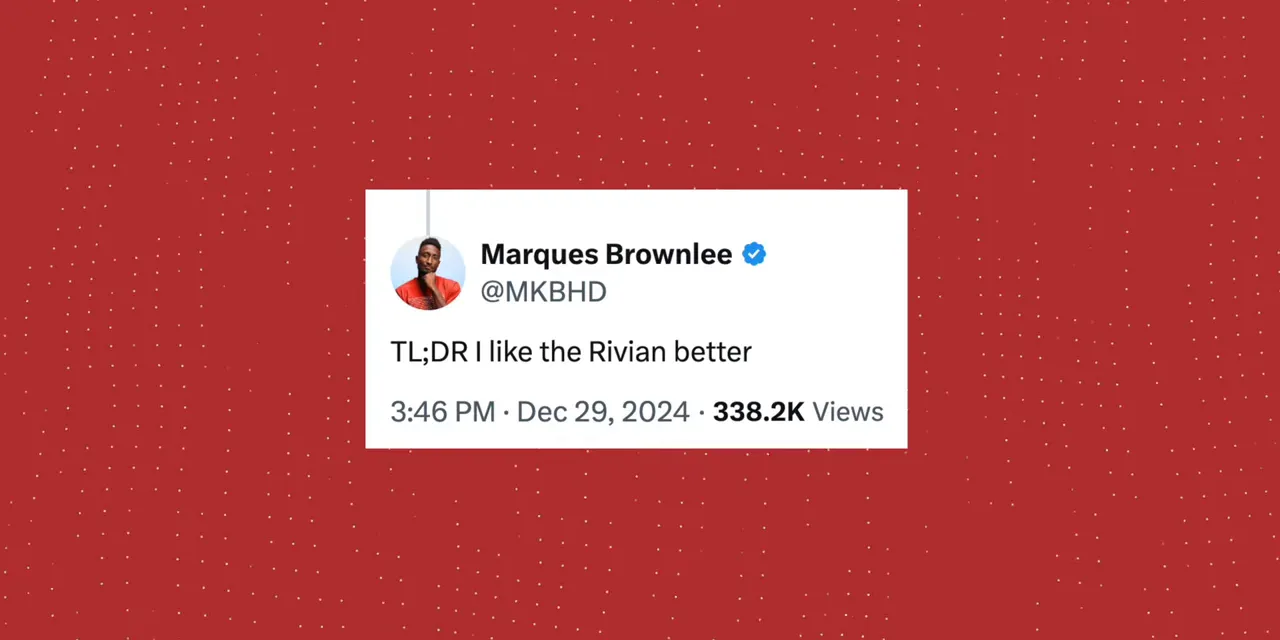
That was enough to upset at least one very important person at Tesla. Since then, I have not been invited to Tesla events or given access to vehicles for review.
Fine. They are allowed to make that choice.
My solution has been to work with a local car dealer in New Jersey. When the dealer gets a new vehicle, I can borrow it and continue reviewing it honestly.
There is still a cost. A later review generally will not attract as much attention as the first wave of coverage from people with early access. Companies do hold some power there. The only way I can earn trust is by not letting that change the substance of my coverage, again and again.
Fortunately, that kind of cutoff has not been the typical response. With almost every company whose products I review, criticism is a normal part of the relationship. I am upfront about that.
One of the coolest outcomes is sitting in a briefing for a second-generation product and meeting engineers who are excited to show me that they fixed something I criticized in the first version. That is a much better result than avoiding the criticism in the first place.
Trust Takes Repetition, Not a Perfect Policy Statement
Trust is built through repeated actions. It is a little like a muscle: it gets stronger through use, not because you announce that it exists.
The same is true of reviewing. Early on, it can be hard to feel confident in your judgments. Experience helps you recognize when something is genuinely great, when something deserves criticism, and how to explain all the nuance between those extremes.
That middle ground matters. Tech discussions can lose the texture that makes a product interesting: the trade-offs, the things that work well for one person and poorly for another, and the difference between an impressive idea and a good everyday experience.
Even after roughly 1,800 videos, I still feel I have a long way to go. I am trying to balance useful technical detail with storytelling and attention to the most interesting parts of the technology.
I will never make the perfect review. I am going to keep trying to make better ones.
So, can you trust MKBHD? These are my policies, these are the pressures involved, and this is how I have handled them. The track record is there for you to evaluate. The decision is yours, and the accountability matters.


