We’ve shot our last video in this studio. Ever.
That’s a pretty crazy sentence to write. Nearly two decades ago, I started making tech videos in a corner of my bedroom at my parents’ house. There wasn’t a business plan. It wasn’t a job I was trying to get. It was just something fun that I wanted to do.
Somehow, I’ve been lucky enough to keep doing it, build an awesome team, and keep finding ways to make the work better. The spaces we’ve worked in have been a huge part of that evolution.
Now we’re moving into a studio that we actually own. I found the space about four years ago and have been quietly working on it ever since. But before that next chapter, this place deserves a proper send-off, including the less glamorous rooms that make everything else possible.
From a Bedroom to a Big Empty Box
I’ve always thought about the channel in eras. Each one had its own constraints, and each move opened up something we couldn’t really do before.
The bedroom, dorm room, and apartment eras
The bedroom was studio 1.0. I made a lot of tutorials and software videos there. Getting my first camera meant I could finally point it at physical things and make videos about gadgets, too.
Then came the dorm room. That era only lasted through my freshman year of college, but it was my first move and a pretty serious exercise in making a tiny amount of space work. Somehow, projects like the fastest Mac Mini in the world series happened in there.
The apartment era ran from my second year of college through graduation and about a year beyond it. The layout was simple: bed on one side, studio on the other.
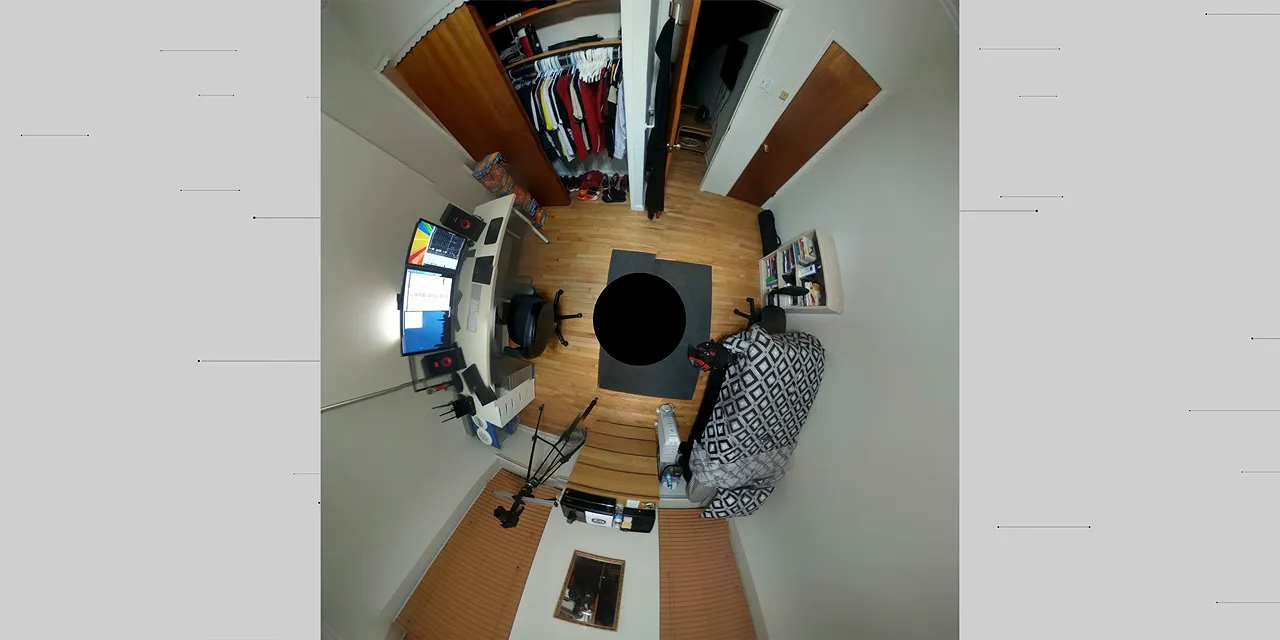
I found a good rhythm in that room. Most of the time, a single window was my key light, which meant making videos while the sun was up. I learned a ton. Believe it or not, there was even enough room to do the first Smartphone Awards.
The first real studio
Around 2016, I saw a billboard that got me thinking: I could rent an empty box in a building somewhere in New Jersey and build a studio inside it.
I went to see the space with my mom while it was still under construction. I liked it, she gave me the green light to sign the lease, and I became one of the building’s first tenants. That made the whole thing feel real.
Of course, renting a big room doesn’t automatically make it a good studio. There wasn’t a how-to guide for what we were trying to build. I’d studied other creators’ studio tours, but a lot of this was experimentation: figuring out what looked good, what sounded good, and what actually improved the process.
At first, the space was basically an echo chamber. Putting foam in the ceiling and manually laying carpet tiles made a massive difference. We built our first top-down set, got a proper closet for camera gear, and celebrated an internet connection that could upload at 100 megabits per second.
At the time, that felt ridiculously fast.
The Goal Has Always Been “More Better”
Once this became my full-time job, the hours that used to go into schoolwork could go into making videos. But more time only solves part of the problem.
Making more videos and making better videos tend to pull in opposite directions. Increase the output, and quality can slip. Increase the ambition of every project, and it gets harder to finish as many of them.
So everything we built was aimed at doing both. More better. Better workflows, fewer repetitive setup tasks, and a team that could help raise the quality without grinding everything to a halt.
Over roughly five years, four of us filled that first studio with desks, sets, and equipment. Eventually, we rented two smaller satellite spaces down the hall: one for top-downs and one for our first camera robot, Mia.
For a while, getting a top-down shot meant carrying everything down a hallway past unrelated businesses, shooting it, and carrying everything back. Not exactly peak efficiency.
When the building’s owners offered us first dibs on a new expansion space, I said yes pretty quickly.
In 2020, during all the uncertainty of COVID, I moved the contents of those three spaces downstairs, piece by piece. Desks, furniture, equipment, everything. I even pulled up the carpet tiles individually and put them back together in the new space.
It was a huge empty box for four people. Then we kept building. Today, 15 people work here across our channels. This is basically the final boss of our rented big-box studios.
The responsibility has grown with it. The publish button carries weight, and we take that seriously. The studio exists to help us make the highest-quality work we can.
The Bullpen: Where Devices Become Ideas
The studio is about 7,000 square feet in total. The bullpen is the desk area, with my setup tucked into a corner. That’s where a lot of brainstorming, writing, and sometimes editing happens.
Next to my desk is a separate area for incoming devices. It’s the testing, experimenting, figuring-it-out zone. Having somewhere to spread things out matters, especially when I’m still deciding what a product does well, what’s interesting about it, and whether there’s a video there.
Near the entrance, our reception area doubles as an initial unboxing station. Packages arrive, we open them, and we start figuring out what deserves more attention. The nearby worktables let that process continue without taking over every desk.
And yes, the old carpet tiles are still here. About 3,000 square feet of them came downstairs from the original studio. After roughly a decade, they’re not exactly aging gracefully, but they’ve put in the work.
The Top-Down Room: A Favorite Shot, Always Ready
The top-down room might be one of the most specifically tech-video rooms in the building. Unboxings, hands-on demonstrations, close looks at devices: a lot of those overhead shots happen right here.
The big upgrade wasn’t just getting enough room for the equipment. It was getting enough room to leave the equipment set up.
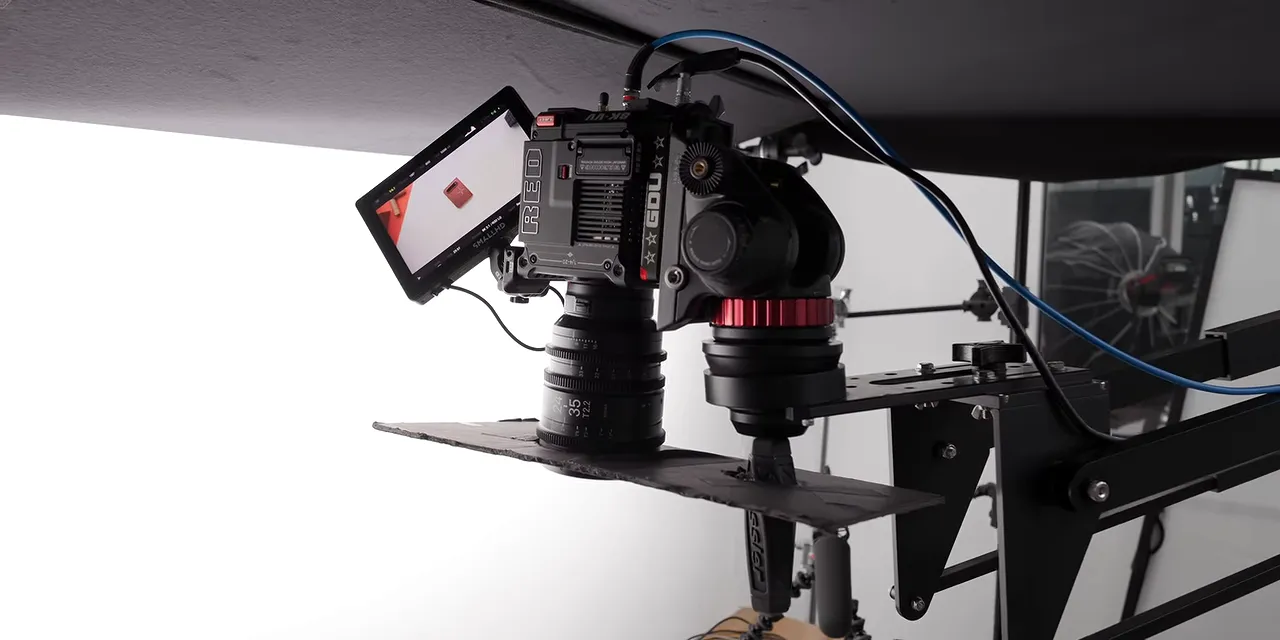
The camera stays on its jib. It doesn’t leave. There’s an S60-C light with brightness and color controls, a large height-adjustable table, and a connected TV so I can check the composition while working.
Instead of rebuilding the rig every time, we can put in a card, bring over a device, and start getting the shot. I like top-downs. I want to use a lot of them. Making them easy to capture is the whole point.
There’s also a little secret behind the different tabletops. Apart from a few butcher blocks, almost all those surfaces are approximately 3-by-4-foot aluminum plates covered in dbrand skins.
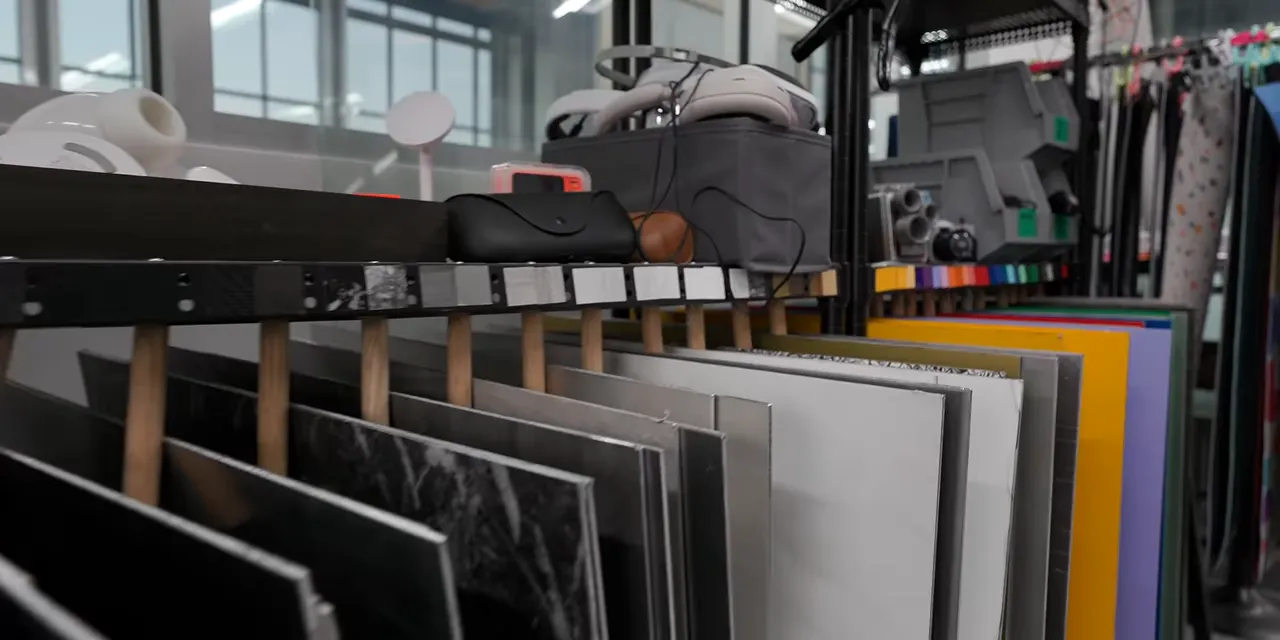
So, no, we don’t haul in a different marble table every time.
On the other side of the room are shelves of props we’ve accumulated over the years. Sometimes something arrives, looks cool, and earns a permanent spot. Those shelves are where a lot of the little background details and Easter eggs come from.
White Wall Room and Gray Wall Room
We have two main set rooms. One has white walls. The other has gray walls.
Incredible naming creativity, I know.
White Wall Room gives us space to build a set around a particular device or topic. We can bring in furniture, lights, backgrounds, and props to make the visuals fit the thing we’re talking about, rather than forcing every subject into the exact same corner.
Gray Wall Room serves a similar purpose, but the gray walls are especially fun with colored lighting. Put color on the wall, and it shows up really nicely.
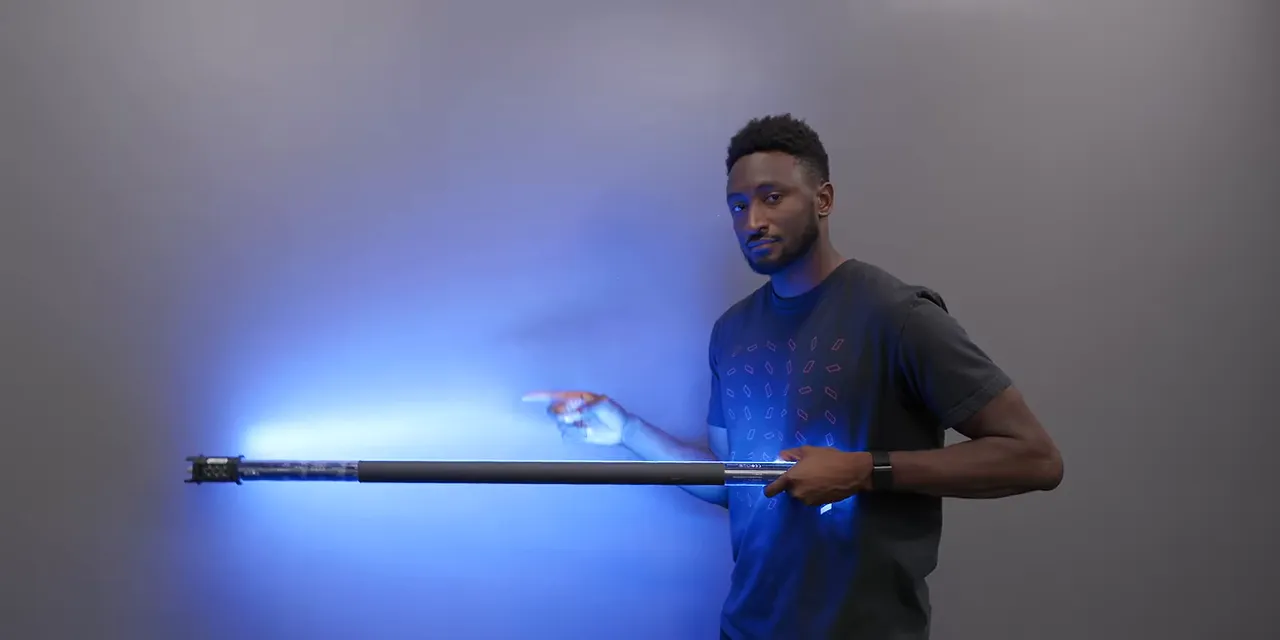
Having two rooms is also a very practical production decision. We can build and record one setup in White Wall Room while another project gets built in Gray Wall Room. That second project might be for a different video or an entirely different channel.
Separate rooms let preparation happen in parallel. We don’t have to tear down one thing before we can even start assembling the next.
Mia, Colossus, and the Robot Room
The recreation area has changed a little over the years. There’s still a pool table, but it lives underneath a ping-pong top now. After years of billiards, we discovered that people here like ping-pong a lot more.
Nearby is Mia, our original camera robot. We kept it after upgrading, partly because it’s a nice reminder of where we started.
The newer robot is called Colossus, and it has its own room.
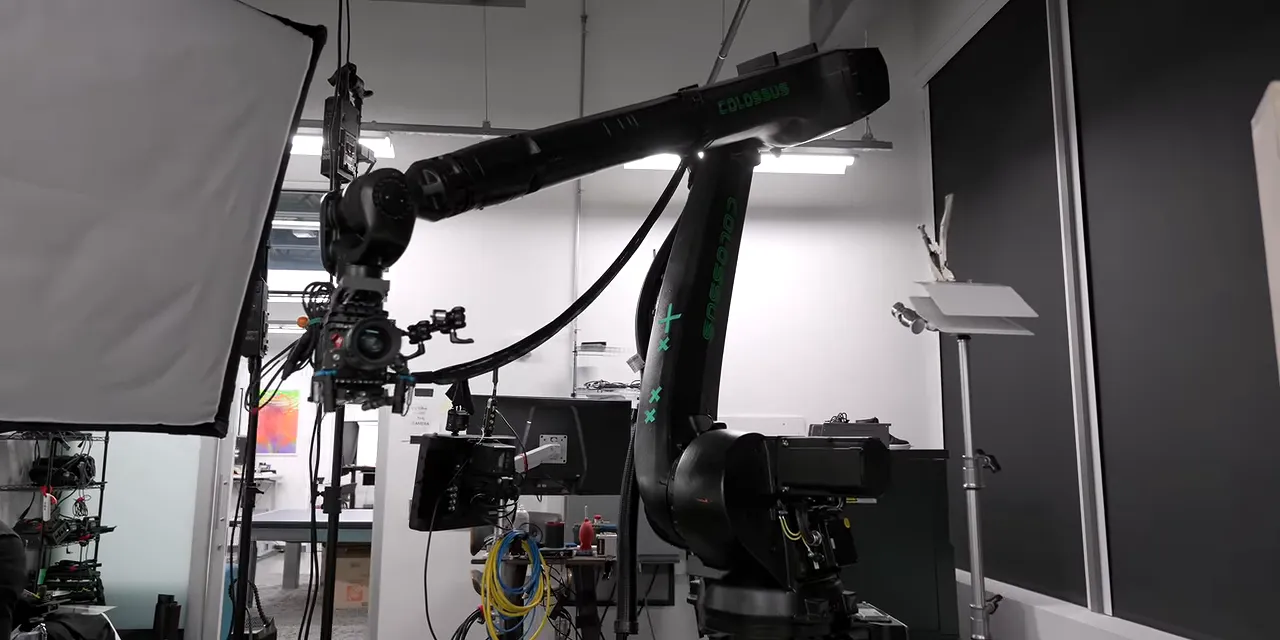
This entire setup exists to make the occasional robot shot possible. I try not to overdo those shots, but they are really fun.
Colossus has substantially more reach than this room gives it space to use. It sits on a weighted base, needs a bunch of extra power, and can be programmed through motion-control software using a PlayStation 5 controller. Which is awesome.
Moving it to the new studio is going to be a project all by itself. But yes, it’s coming with us.
The Gear Room: Everything Has a Place
Camera storage started as a drawer in my desk. Then it became a closet. Now it’s an entire gear room.
There’s a lot packed into it, but the organization is pretty straightforward:
- RED cameras and mirrorless cameras have their own areas.
- RF, EF, and PL lenses are grouped separately.
- Filters and other things that go in front of lenses stay together.
- Batteries and chargers have a dedicated station.
- Microphones, accessories, cables, and tripods have assigned spots.
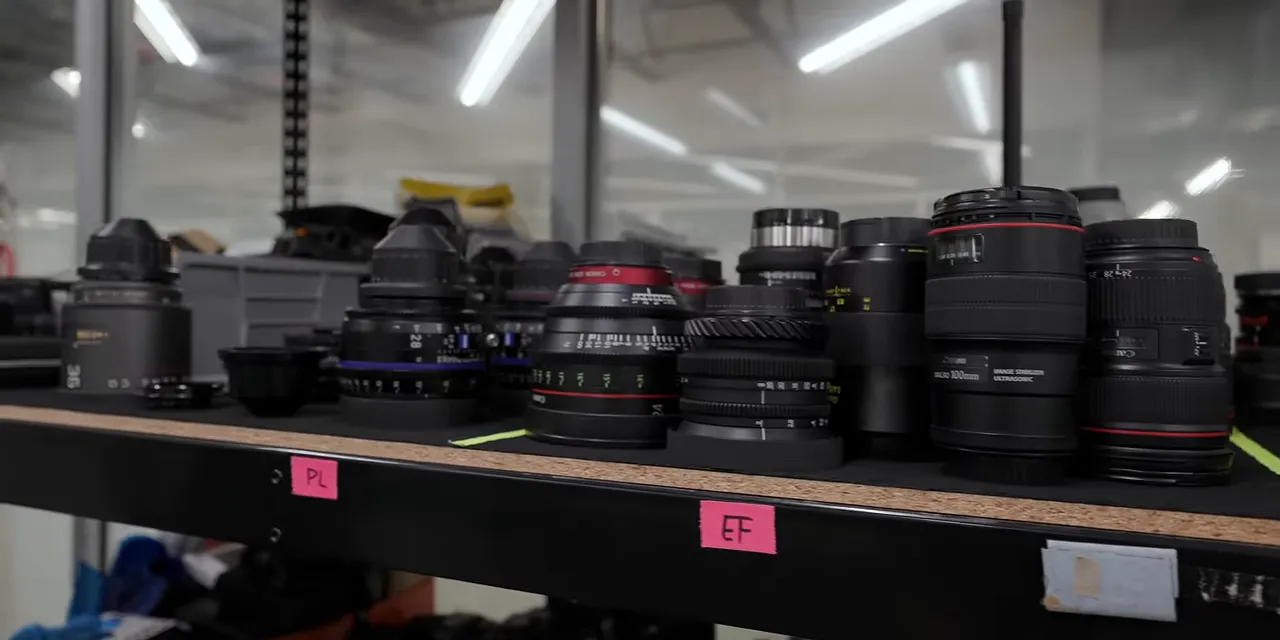
The idea is that everyone knows where things belong. You come in, build the camera rig you need, grab a battery, and go shoot. If a project requires extra equipment, a cart can carry it along.
All of this gear is moving with us. Having a proper place for it remains a big part of the plan.
The Less Glamorous Stuff That Keeps Production Moving
A surprising amount of a tech studio isn’t a set at all. It’s storage, shipping, maintenance, and places to put things that will be useful later.
The device archive
We don’t keep every review device forever. Plenty stay for months or perhaps a year or two before going back. But a lot of the smartphones we’ve purchased are still here, along with headphones and other reference devices.
That archive is useful when we need to revisit an older product or rerun benchmarks. I also check the stored phones periodically for swelling batteries or anything else unusual.
When we reviewed every iPhone ever made, we bought those iPhones. We’ve kept and labeled them so they’re available if we need to revisit them. That entire project now fits into a much smaller collection of storage containers.
The prop room and workshop
The prop room holds artwork, lamps, plants, masks, and all sorts of miscellaneous things we’ll probably need for a future video. How far in the future? Great question.
If a skit needs a name tag or a fake mustache, there’s a decent chance it’s in there.
This room is also our entire workshop, including the 3D printer and filament storage. We have not gotten rid of the casket, either. Keeping that might be a mistake, but it’s still here.
Shipping and long-term storage
Our shipping station handles a slightly unusual requirement: a lot of things arrive, stay for months or years, and then need to leave again. We have to track when they should go back and who should receive them.
Long-term storage holds camera travel bags, packaging, and all those monitor boxes that suddenly become extremely useful when you’re moving an entire studio.
One of the genuinely exciting upgrades in this space was being able to close a door on storage. In the earlier big-box studios, storage was often just a pile in the corner.
A room with a door is underrated.
Audio Gets Its Own Space
Ellis’s audio room, also affectionately known as the audio dungeon, is the most acoustically treated space in the studio.
There’s foam in the corners, bass traps, and hanging material to reduce reflections. It’s a small room, so a rug and couch also make a meaningful contribution.
This is one of those areas where we’ve learned a lot by building, using the room, and discovering its limitations. Those lessons are going straight into the new building.
The surprisingly tiny Waveform studio
People who visit often expect the Waveform podcast room to be much bigger.
It’s actually the smallest room in the studio.
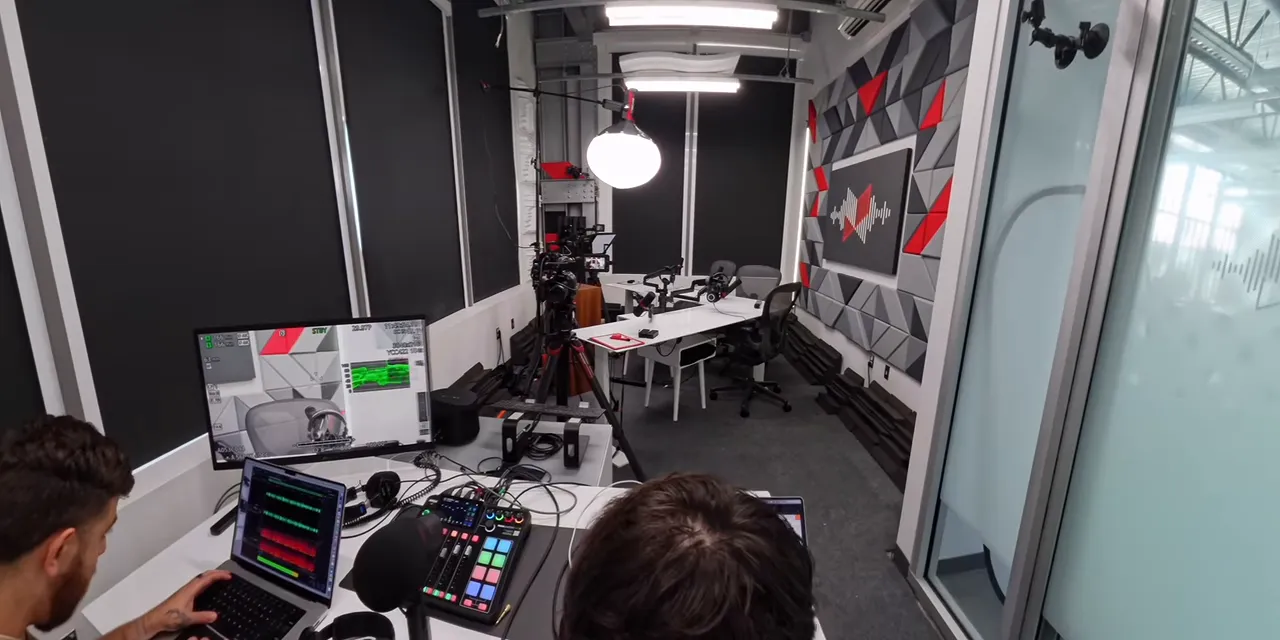
We chose it partly because good audio is so important for a podcast, and this space would be the easiest to treat. There are bass traps, an acoustic wall, and a table where we sit each week to talk through the latest tech stories.
Two cameras on tripods cover the hosts. A single central light illuminates everyone around the table, and a C500 covers the producers at their desk.
It’s small, but it does a lot of work.
Just outside is a five-in-one reflector that gets used for more than one job. Sometimes we take it outside to diffuse sunlight. Sometimes it becomes a white background for thumbnails, many of which are photographed in the podcast room.
A Workplace, Not Just a Collection of Sets
The middle of the studio isn’t where we shoot most of our videos. It’s where we eat lunch together and hang out.
At the back, there’s a kitchenette and a huge Herman Miller table, which was the first piece of furniture I bought for this space. The nearby windows and lights make that area useful for B-roll, too.
Our TV setup gives us somewhere to test game consoles and make gaming-related videos. Depending on the project, we can move a couch over and turn it into another useful shooting area.
That’s how a lot of this studio evolved. A room would start with one purpose, then we’d discover another use for it. Over time, those little improvements added up to a place that could support an entire team and multiple channels.
It also became our home away from home.
Starting Over, but Not From Zero
Leaving is bittersweet. We’ve made so much here that every room feels familiar, and we’ve pretty clearly filled the place up.
But owning our next studio has been the goal for a long time. Finding the building was only the beginning. The years since have gone into applying what we learned from the bedroom, the dorm, the apartment, the first empty box, and this much bigger one.
The names and purposes of these rooms will carry forward. The top-down space, the set rooms, the gear storage, the audio rooms: all of those ideas are coming with us, with improvements based on actually living and working in them.
The next chapter starts with the empty building, followed by the finished studio. I’m incredibly excited to share both.
It’s a fresh start built on everything that came before it.
A Thank-You to Ridge
Support for the work, including merchandise purchases and longtime sponsors, helps make a move like this possible. Ridge has been one of those longtime sponsors, and its product lineup has evolved quite a bit, too.
It’s not just wallets anymore. There’s luggage, jewelry, water bottles, key cases, and now tech accessories.
The 10,000 mAh wireless charging power bank I’ve been using has built-in cables, 20-watt fast charging, an Apple Watch charger, and a kickstand. Being able to charge my watch alongside other devices makes it a handy multi-device travel charger.
Ridge’s tracker card supports Apple Find My and Google Find Hub, offers roughly 10 months of battery life, and recharges wirelessly. At the time of this studio farewell, Ridge was also promoting a holiday sale with discounts of up to 49%.


